Visa and Mastercard are accepted in the same places in major markets. In the United States, both reach about 10.7 million merchants, and both are reported at about 99% domestic acceptance, so the practical differences usually come from regional exceptions, merchant routing rules, and card-category economics rather than logo coverage.
That makes most “Visa vs Mastercard acceptance” advice outdated. A logo on the terminal tells you only that the merchant supports a network. It doesn't tell you whether the issuer will approve the transaction, whether a dual-badged card will be routed over the preferred rail, or whether a crypto-linked card is eligible for that merchant category.
The useful question is narrower: when does the network choice change whether the payment goes through? In everyday U.S. retail, rarely. Abroad, at ATMs, in card-not-present transactions, and with prepaid or crypto-linked products, the issuer, card type, regional configuration, and merchant rules matter far more.
Table of Contents
- Why "Which Is Accepted More" Is the Wrong Question
- Global and US Acceptance Numbers Compared
- ATMs, Travel, and Regional Exceptions
- Merchant Routing Rules and the 2026 Shift
- Crypto Card Availability by Network
- Choosing by Country and Use Case
- Frequently Asked Questions About Network Acceptance
Why "Which Is Accepted More" Is the Wrong Question
Visa and Mastercard have already won the acceptance contest in the markets most readers care about. Both networks operate across more than 200 countries and territories, and their merchant footprints overlap heavily. An academic and industry estimate cited by MyBankTracker's global acceptance comparison found that the vast majority of retailers accepting Visa also accept Mastercard.
So stop treating a declined transaction as proof that one logo has weaker reach. A Visa card refused in Bogotá, or a Mastercard rejected by an online travel merchant, may be blocked because of the issuer's fraud model, the card's BIN classification, the merchant category, cross-border controls, or the transaction channel. The network brand is only one input.
Start with the transaction, not the logo
Use this order of diagnosis:
- Identify the channel. A chip transaction at a supermarket is different from a manually entered online payment, a recurring charge, or an ATM withdrawal.
- Identify the card category. Debit, credit, prepaid, commercial, and crypto-linked cards can receive different treatment even when they carry the same network logo.
- Check the issuer. The issuer decides account controls, geographic permissions, available balance, fraud screening, and much of the approval logic.
- Check routing. A merchant may support both networks but prefer one rail, especially when a card carries multiple brands or debit applications.
- Check the region. Local routing schemes and domestic payment partnerships can affect the result.
For crypto-card users, this distinction is decisive. A card may process like an ordinary Visa or Mastercard payment at the point of sale, but the issuer still has to authorize the spend, convert or release the underlying balance, and satisfy its compliance and risk rules. The practical usage question is covered more directly in where you can use a crypto card.
Practical rule: Treat “accepted by Visa” or “accepted by Mastercard” as a compatibility signal, not an approval promise.
The right comparison therefore moves away from slogans such as “Visa is more accepted” and toward payment-rail fit. For a U.S.-only cardholder, the logo is usually irrelevant. For a traveler or crypto user, regional issuance, ATM relationships, merchant category restrictions, and dispute handling can matter immediately.
Global and US Acceptance Numbers Compared
The raw footprint shows why broad acceptance claims rarely settle the decision. One industry summary places Visa at about 44 million merchant locations worldwide and Mastercard at about 37 million, while noting that Mastercard has an edge in country count and Visa has an edge in merchant count. Another industry source reports that both networks exceed 150 million acceptance locations across more than 200 countries and territories. These figures use different counting methods, so they shouldn't be treated as directly interchangeable.
The honest conclusion is not that one network works everywhere and the other doesn't. It's that both have near-saturated acceptance in major markets, with differences appearing in measurement methods, acquiring relationships, and local deployment.
| Metric | Visa | Mastercard |
|---|---|---|
| Broad global reach | Accepted in 200+ countries and territories | Accepted in 200+ countries and territories |
| Merchant-location estimate cited by industry summary | About 44 million | About 37 million |
| U.S. merchant acceptance reported in 2024 comparison | About 10.7 million | About 10.7 million |
| U.S. purchase volume in 2022 | 70.48% | 29.52% |
| Practical U.S. acceptance assessment | About 99% | About 99% |
The U.S. volume split is important, but it doesn't mean Visa reaches more checkout counters. The Nilson Report comparison of U.S. cards reports Visa at 70.48% of U.S. purchase volume in 2022, versus Mastercard at 29.52%. That is a measure of network share, not a direct measure of whether a merchant can accept the card.
What the U.S. numbers actually mean
For a U.S. shopper, both networks are effectively tied on broad merchant acceptance. The practical issue is whether the merchant accepts the specific card type, whether the issuer permits the transaction, and whether the merchant's processor can handle the authorization path.
That distinction matters even more for crypto-linked cards. A prepaid or debit-style crypto card may be treated differently from a conventional credit card. A merchant might accept the network while restricting prepaid products, international BINs, or transactions associated with certain categories. The logo passes the first test, but the card's product classification fails the next one.
Acceptance tells you whether the door is open. Authorization decides whether you can walk through it.
Before choosing a crypto card, compare the issuer's supported regions, card type, funding model, and network rather than selecting Visa or Mastercard in isolation. A consolidated view of regional issuance and product coverage is available through NomadCards' card availability data, where network compatibility can be evaluated alongside the terms that affect use.
ATMs, Travel, and Regional Exceptions
Point-of-sale parity hides the places where cardholders notice network differences first. ATM access, cross-border acquiring, and local partnerships can produce a different experience from tapping at a major retailer.
Visa routes cash withdrawals through the Plus network, while Mastercard uses Cirrus. Both have broad international ATM coverage, but the density and reliability of local connections vary. A card that works smoothly at one bank's ATM may fail at another because of issuer restrictions, local transaction limits, unsupported card categories, or the ATM operator's configuration.
Where regional context matters
Visa has often been associated with stronger reach in parts of Latin America, while Mastercard can have stronger relationships in selected African markets. Those are useful starting assumptions, not guarantees for a specific city or card. Travelers should verify the issuer's ATM policy and test a small withdrawal before depending on one card for cash.
| Region | Visa edge | Mastercard edge |
|---|---|---|
| Latin America | May offer stronger local ATM or acquiring relationships in some markets | Can still provide broad acceptance, with outcomes depending on issuer and bank |
| Selected African markets | Broad international reach, but local coverage varies | Can be stronger in particular ATM and merchant ecosystems |
| Caribbean hospitality | Some travel and hospitality environments may lean toward Visa relationships | Acceptance remains broad, but issuer partnerships can change the result |
| Mainland China | Network access depends heavily on local acquiring and merchant setup | Some Mastercard merchant pickup can be limited in particular environments |
| European Union | Cross-border use is broadly strong | Domestic debit and routing arrangements can affect processing |
Travelers also overfocus on foreign transaction fees as a network feature. In practice, the issuer sets the card's fee policy, while the merchant or ATM may add its own conversion charge. A Mastercard with no foreign transaction fee can be more useful than a Visa with a fee, and the reverse can also be true. The network logo doesn't settle the economics.
What to carry abroad
A dual-network wallet is more sensible than loyalty to one brand. Carry a primary card, a backup on the other network when possible, and a payment method that doesn't depend on the same issuer. Keep local currency or another fallback for transport, unattended terminals, and merchants with restrictive acceptance policies.
Don't confuse dynamic currency conversion with network acceptance. If a terminal offers to charge you in your home currency, that's a pricing decision made at checkout, not evidence that Visa or Mastercard is superior. Decline the conversion when you understand the alternative and let your issuer handle the exchange, subject to its own terms.
Merchant Routing Rules and the 2026 Shift
The next phase of acceptance is about which network processes the payment, not whether the merchant recognizes the logo. U.S. merchant rules changing in 2026 allow merchants to accept or decline categories such as Visa debit, consumer credit, premium consumer credit, or commercial cards. The Nilson Report overview of worldwide card acceptance locations describes why acceptance is becoming a saturation and routing issue rather than a simple brand comparison.
A dual-badged card can therefore face a routing problem. The terminal may recognize both applications, but the merchant's configuration can favor one network, restrict a card category, or reject the available route. Authorization and clearing are also different stages. An authorization can be approved initially, while final processing depends on the merchant's submitted data and the selected rail.
| Merchant type | Common routing choice | Cardholder impact |
|---|---|---|
| Grocery chain | Preferred debit or credit network configured by the processor | A dual-badged card may be routed away from the cardholder's expected network |
| Travel merchant | Lower-cost or preferred cross-border rail | Online or foreign transactions may receive stricter issuer scrutiny |
| Fuel or unattended terminal | Restricted card categories or delayed verification | Prepaid and crypto-linked cards can be more vulnerable to declines |
| Online subscription merchant | Tokenized or stored-credential route | Regional token or issuer controls can affect recurring approval |
Merchant economics sit underneath these choices. For a practical explanation of how interchange, assessment, processor, gateway, and other charges fit together, see this payment processing fees guide. The important point for cardholders is simple: merchants optimize their acceptance stack, and the network with the strongest logo isn't automatically the route they want to use.
Crypto cards feel this pressure more sharply because issuers may classify them as prepaid, debit, commercial, or another program type. They can also apply additional controls when settlement involves a crypto balance, a stablecoin conversion, or a nontraditional funding source. If a merchant accepts the brand but refuses the card, crypto card declined reasons and fixes is the right troubleshooting frame.
A supported logo gets your transaction considered. The merchant's route and the issuer's risk decision determine whether it survives checkout.
Crypto Card Availability by Network
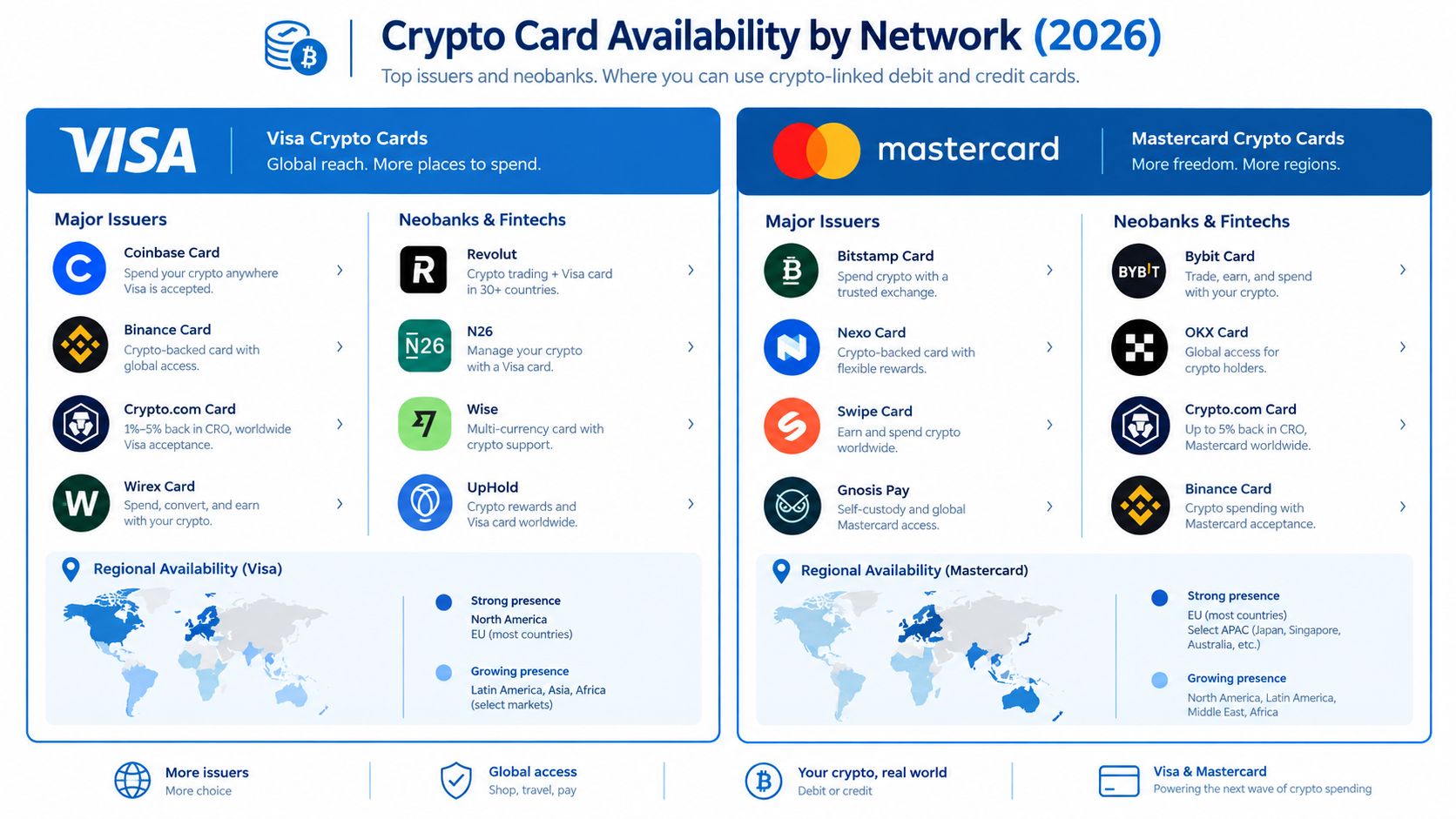
Network choice matters more for crypto cards because availability is issuer-led. Visa and Mastercard provide the payment rails, but an exchange, fintech, or card program manager decides where the product can be issued, which assets can fund it, what verification is required, and how rewards work.
A Visa crypto card may be available through one issuer in North America or Europe while a Mastercard program has stronger coverage in selected European or Asia-Pacific markets. Another issuer can make the opposite choice. There is no universal network advantage that overrides regional licensing, banking relationships, compliance approvals, or the economics negotiated by the program.
Compare the program behind the card
The issuer's terms deserve more attention than the front logo:
- Funding model: Some cards spend a fiat balance after conversion, while others connect spending to a crypto account or wallet structure.
- Card classification: A debit, prepaid, secured, or credit product can face different merchant rules.
- Regional issuance: A card available in the United States may not be issued in the United Kingdom, European Union, Latin America, or Singapore.
- Rewards design: Cashback, points, and promotional rewards depend on the issuer's economics, not on Visa or Mastercard alone.
- Disputes: The network supplies dispute frameworks, but the issuer handles the customer relationship, evidence collection, and account decision.
Declines often cluster around merchants that use deposits, delayed settlement, or special risk controls. Prepaid services, airline direct bookings, and some travel aggregators can be difficult for crypto-linked cards because the merchant may need a hold, a guaranteed funding source, or a card category it accepts only selectively.
Stablecoin spending adds another layer. The merchant typically receives a conventional card payment, while the issuer manages the conversion or balance deduction behind the scenes. If that conversion fails, the issuer blocks the transaction, or the merchant rejects the card category, changing networks may not solve the problem.
Some exchanges issue exclusively on one network because supporting two networks can mean separate contracts, certification work, settlement operations, fraud tooling, and regional program economics. That decision can reflect issuer strategy rather than a claim that one brand reaches more merchants.
NomadCards can help compare those program variables in one place. Its product profiles and finder organize network, region, card type, supported assets, verification requirements, fees, rewards, and custody characteristics, which is the information a crypto user needs before treating Visa or Mastercard as the deciding factor.
Choosing by Country and Use Case
Country matters, but it shouldn't be your only filter. The stronger decision combines destination, transaction type, card category, and issuer availability.
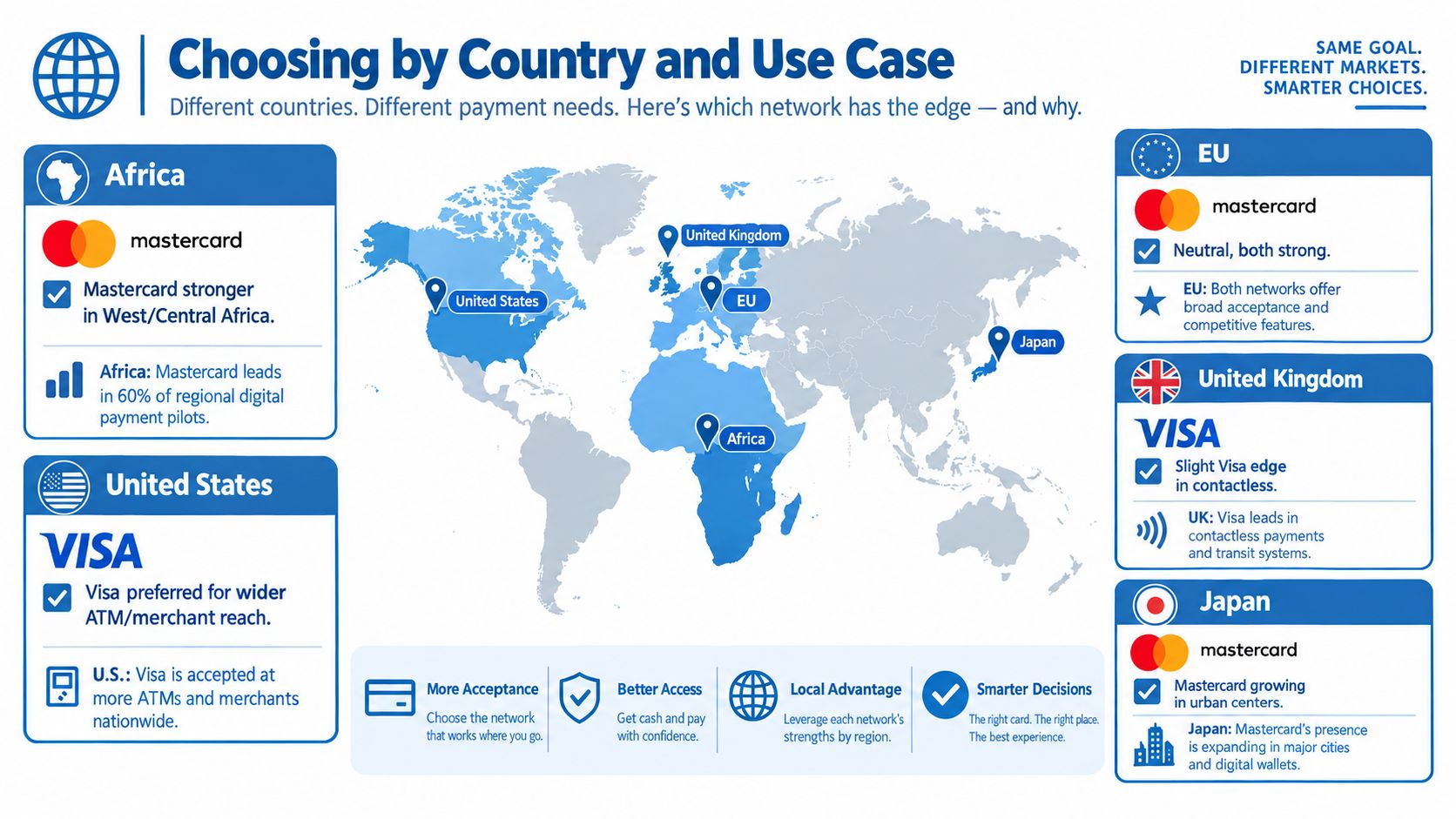
In parts of Africa, Mastercard may have stronger relationships in selected merchant and ATM ecosystems. In Latin America, Visa can be a sensible first choice where local acquiring and ATM access favor it. In the European Union, both networks are strong for international card use, but domestic debit schemes and local routing can influence which rail handles a payment. The United Kingdom and Japan can also deliver different outcomes by issuer, merchant segment, and contactless configuration.
Match the card to the job
For U.S.-only spending, choose based on issuer approval quality, fees, rewards, and card category. Broad Visa and Mastercard acceptance is already close enough that the logo should be a secondary criterion.
For frequent international travel, prefer a dual-badged card when available, then verify ATM access, foreign transaction fees, cash withdrawal rules, and support in the countries you visit. A second card from a different network is a practical backup, not an admission that either network is unreliable.
For African travel, compare Mastercard programs carefully where the issuer has documented local coverage or ATM relationships. Don't assume that a globally marketed card has the same functionality in every country.
For European travel, inspect whether the card is issued locally or cross-border. A local issuer partnership can affect verification, tokenization, cash access, and merchant approval more than the logo.
For crypto spending, start with the issuer's regional availability and restrictions. Then check card type, supported assets, conversion rules, merchant-category exclusions, dispute process, and wallet or exchange custody.
The decision tree is straightforward:
- Need U.S. retail only? Pick the stronger issuer economics.
- Need multiple countries? Pick the program with confirmed regional issuance and carry a backup network.
- Need cash? Compare ATM access and withdrawal rules in each destination.
- Need crypto funding? Check card classification and excluded merchant categories before comparing rewards.
- Need recurring online payments? Prioritize issuer tokenization and account-updater support.
The network is the final check, not the first one.
Frequently Asked Questions About Network Acceptance
Does a dual-badged Visa and Mastercard eliminate the choice?
It reduces the coverage risk, but it doesn't eliminate payment decisions. The merchant terminal, processor, card category, and issuer can still determine which application is selected. A merchant may accept both brands generally while restricting one route or declining a particular prepaid, debit, commercial, or crypto-linked category.
Why can a crypto card decline when the merchant accepts the logo?
The issuer may block the transaction because of geography, balance conversion, fraud screening, merchant category, card classification, or a temporary authorization issue. Online merchants can also apply stricter controls to international BINs, stored credentials, and card-not-present transactions. Test the same card at a conventional chip terminal, then review the issuer's decline reason instead of assuming the network failed.
How should I confirm acceptance before traveling?
Check the issuer's country list, ATM policy, card type, foreign transaction terms, and merchant-category exclusions. Contact the destination merchant for unusual purchases, especially hotels, car rentals, airlines, and unattended terminals. Carry another card and don't rely on a single issuer's approval system.
Does debit network choice matter as much as credit?
It can matter more in markets where merchants or processors actively manage debit routing. A dual-badged debit card may be sent over a preferred network, while a credit transaction follows different merchant rules. The card's application and issuer terms matter more than the printed logo alone.
What should I check after repeated refusals abroad?
Look for a regional lock, offline or fallback transaction attempt, a tokenization mismatch, an unavailable balance conversion, or a BIN-level restriction. Ask the issuer whether the decline is coming from the merchant, acquirer, network, or issuer. Merchants comparing terminal and gateway expenses can also benefit from this overview of small business POS and gateway costs in South Africa, because the acceptance path often explains why a supported card still fails.
The practical verdict is clear. Visa and Mastercard are broadly interchangeable at major merchants, while issuer economics, card classification, regional routing, and merchant configuration create the meaningful differences. Choose the program that fits your destination and spending pattern, then use the network as a compatibility check rather than a marketing promise.
NomadCards helps you compare crypto-linked debit and credit cards by network, region, fees, rewards, supported assets, verification requirements, and custody model. Visit NomadCards to narrow your options before you travel or move everyday spending onto a crypto card.