MiCA (Regulation (EU) 2023/1114) is the EU-wide rulebook for issuing, offering and providing services for crypto-assets, applying in phases from 30 June 2024. If your crypto card carries a familiar payment logo and calls itself EU compliant, does that tell you who is responsible if the platform holding your crypto fails?
That gap is where most confusion starts. A card isn't one regulated product. It's a chain of separate firms, and each link can sit under a different rulebook, supervisor and set of protections. Understanding what is MiCA regulation therefore means learning to read that chain entity by entity, rather than trusting the brand printed on the plastic.
Table of Contents
- What MiCA Regulation Covers in Plain Terms
- Key Dates From 2024 to 2027
- Who Supervises MiCA
- Obligations and Authorisation Under MiCA
- Who Is Covered on a Crypto Card
- Misconceptions and Checks Before You Spend
What MiCA Regulation Covers in Plain Terms
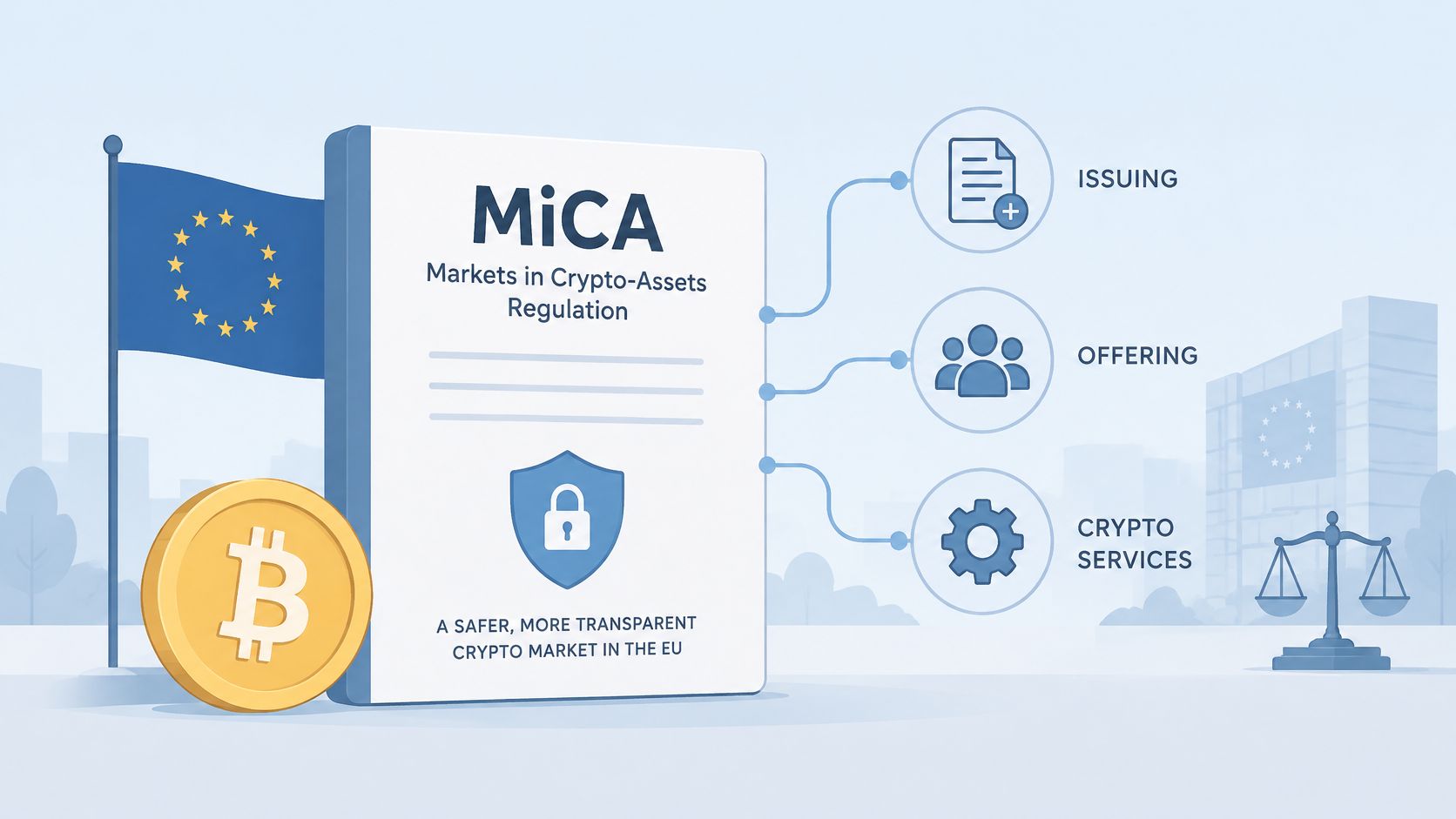
MiCA, short for Markets in Crypto-Assets, is the EU-wide rulebook for issuing, offering and providing services for crypto-assets that existing financial law doesn't already cover. It acts as a single driving licence for the whole bloc. Before MiCA, a firm could be registered in one member state and serve customers elsewhere while each country applied different rules. MiCA replaces that patchwork with one set of rules, so an authorised firm works to the same baseline wherever its EU customers live.
The regulation sorts products and firms into categories first, then attaches duties to each category. That sorting matters because the label decides what the issuer or provider must prove, disclose and hold in reserve.
The Five Categories You Will Meet
| Category | What it covers | Typical example |
|---|---|---|
| Asset-referenced token (ART) | Stablecoin that seeks stable value by referencing a basket of assets, rights or currencies | Multi-asset backed stablecoin |
| E-money token (EMT) | Stablecoin that references one official currency | Single-currency stablecoin pegged to the euro or US dollar |
| Other crypto-asset | Tokens not already governed by existing financial-services law | Utility or governance token |
| Crypto-asset service provider (CASP) | Firms providing exchange, custody, transfer or advisory services | Licensed crypto exchange or custodian |
| Algorithmic token | Token that tries to hold value through supply adjustments instead of reserves, checked against the stablecoin and other-asset rules | Algorithmic stablecoin |
Stablecoins get special treatment because people use them as money. Under Regulation (EU) 2023/1114, an EMT references one official currency, while an ART seeks stable value by referencing other assets, rights, or combinations of assets, and rules for both ARTs and EMTs applied from 30 June 2024.
An algorithmic token that expands or shrinks supply to chase a price target can't call itself an ordinary payment instrument just because it aims at one euro. Supervisors look at how stability is claimed and what's behind it. If nothing solid backs the promise, the token doesn't gain credibility from its marketing name.
Practical rule: Ask what a token references and who issued it before you ask what it's called. The reference decides the category, and the category decides the duties.
What sits outside MiCA is just as important. Assets already governed by securities or payment law stay under those rules instead. So start every check the same way. Name the token or service you use, place it in one row of the table, then ask which firm is responsible for that row.
Key Dates From 2024 to 2027
| Date | Milestone | What it means for users |
|---|---|---|
| 30 June 2024 | ART and EMT rules apply | Stablecoins must meet MiCA requirements in the EU |
| 30 December 2024 | Broader framework applies, including CASP requirements | Crypto service providers need MiCA authorisation or valid transitional status |
| 30 June 2025 | Commission interim application report under Article 140 | Early review of issuances, white papers and market data |
| 1 July 2026 | Latest national transitional period ends | Firms without a MiCA authorisation must stop serving EU customers |
| 30 June 2027 | Commission full application report under Article 140 | Full review including market capitalisation and trading admissions |
MiCA didn't switch on in one day. Stablecoin issuers went first, because a token used for payments raises immediate questions about reserves and redemption. Service providers followed six months later, when exchanges, custodians and transfer firms had to be authorised or rely on a valid national transition.
Why Two Firms Can Have Different Deadlines
Member states could let firms already operating under national rules continue for a limited period while they applied for MiCA authorisation. That window was capped, and the latest of these national arrangements closed on 1 July 2026. After that point, a firm can't rely on transition alone to keep serving EU customers.
National arrangements varied in length and conditions, which is why two similar apps could show different statuses during the changeover. One might hold full authorisation, while another still operated under its home country's older registration. That's not a minor paperwork detail. It changes which protections apply to you today.
The Review Dates That Shape What Comes Next
Under Article 140 in ESMA's interactive single rulebook, the European Commission must present an interim application report by 30 June 2025 and a full report by 30 June 2027, including figures on crypto-asset issuances, white papers, market capitalisation, and trading admissions. Those reviews tell supervisors whether the rules work in practice and where gaps remain.
For you, the useful question isn't when the law was adopted. It's when the firm in front of you had to be authorised, and whether its name now appears on a public register for the exact service you're using.
Who Supervises MiCA
MiCA is enforced in two layers, and knowing which layer does what saves you from sending a complaint to the wrong desk. National competent authorities do the front-line work in each member state. They authorise firms, supervise them day to day and keep public registers you can search before you deposit funds.
Above them, the European Securities and Markets Authority (ESMA) coordinates those national supervisors and sets common technical formats for documents such as white papers and trading records. ESMA doesn't replace your national regulator. It makes sure supervisors in different countries read consistent data and apply the shared rulebook in a comparable way. The European Commission sits above the system in a different role, reviewing how the regulation performs and proposing changes where the evidence points to problems.
How the Passport Works in Practice
Say a crypto-asset service provider is authorised in the Netherlands and wants customers in Spain. It notifies its home authority, and that notification lets it serve Spanish customers for the listed services without applying for a second full licence. The firm remains supervised by the Dutch authority, and its register entry shows which services it may offer.
That example exposes a common misunderstanding. Passporting doesn't mean every EU regulator supervises the firm equally, and it doesn't mean every service the firm might launch later is covered. The register entry is the source of truth.
- Find the home authority: Look for the member state named in the firm's legal footer or register entry.
- Match the service: Confirm exchange, custody or transfer is listed, not just the company name.
- Follow the complaint path: Contact the firm first, then escalate to the authority named in that register entry.
Knowing who supervises a firm tells you where an unresolved problem belongs. Without that name, you're left emailing a support inbox and hoping someone accountable reads it.
Obligations and Authorisation Under MiCA
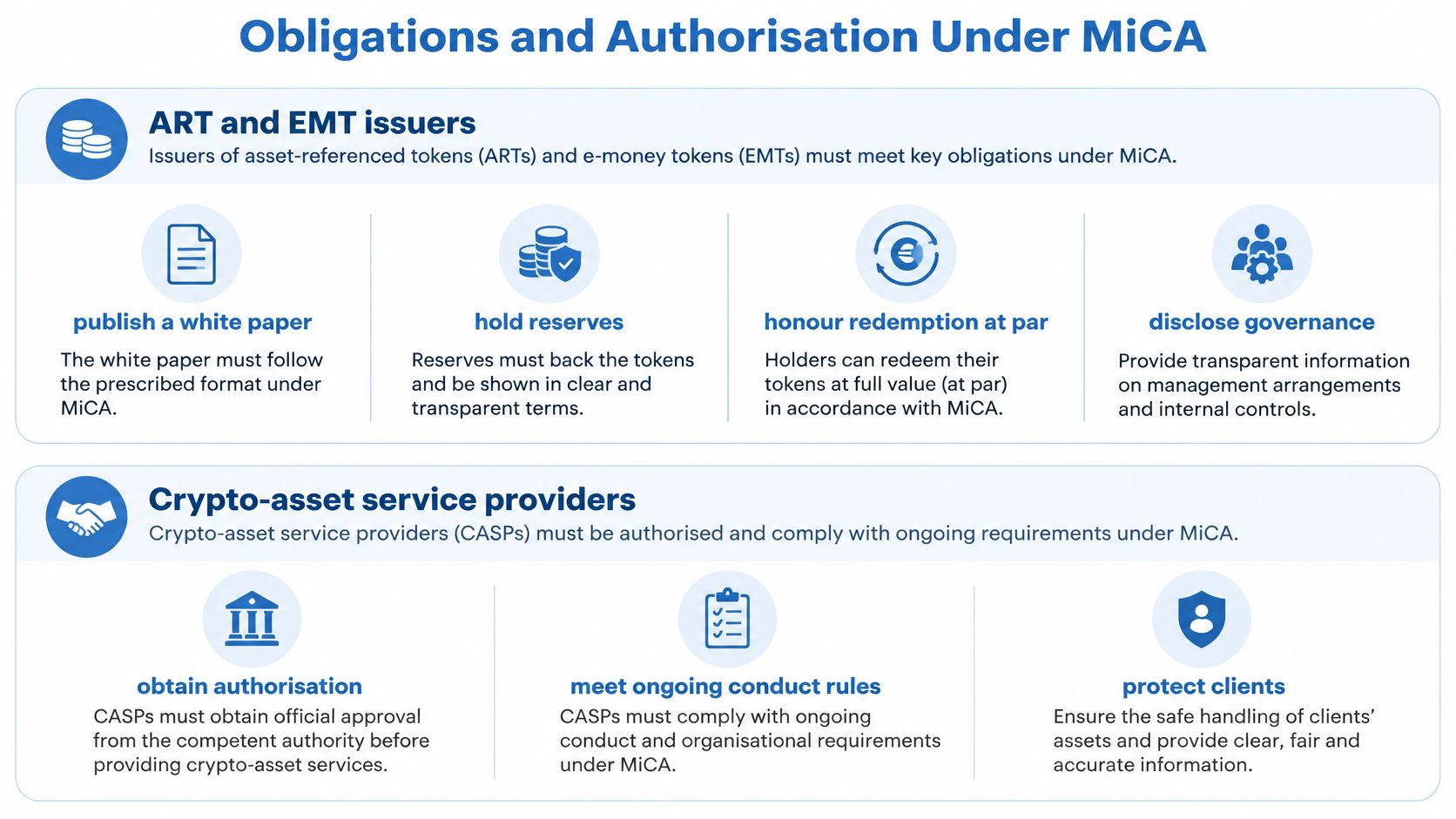
Authorisation isn't a badge a firm buys once. It's a set of continuing duties, and the duties differ by role. The checklist below shows what supervisors expect before a firm serves the public.
Duties by Role
- ART and EMT issuers: Publish a white paper in the prescribed format, hold reserves, honour redemption at par where the rules require it, and disclose how the firm is governed.
- Crypto-asset service providers: Obtain authorisation, safeguard client assets, manage conflicts of interest, run proper complaint handling and maintain operational resilience and cybersecurity controls.
- Both: Give customers clear information about risks, fees and who is responsible when something goes wrong.
Behind those duties sits a data layer most users never see. According to ESMA's MiCA activity page, ESMA specifies technical formats for crypto-asset white papers and standardised records for orders and trades, and provides machine-readable JSON schemas and reporting specifications so authorities can ingest consistent transaction data. Compliance therefore looks like a steady stream of structured records, not a framed certificate in reception.
The short video below walks through how those duties fit together for issuers and service providers.
The Authorisation Route Step by Step
- Choose the home member state and its competent authority, because that authority leads the review.
- Prepare the file with corporate documents, the business model, planned services, the legal-entity identifier, contact details and website.
- Add a third-party cybersecurity audit referencing the EU Digital Operational Resilience Act, known as DORA, where the application requires it.
- Answer supervisor questions on governance, capital and whether managers are fit for their roles. An incomplete file is the classic slip here, because missing material restarts the review clock.
- Receive authorisation for named services only, such as exchange, custody or transfer. One licence doesn't automatically cover every service the firm later advertises.
- Notify through the passport before serving customers in other member states.
If you're comparing providers rather than applying yourself, The Coin Course crypto compliance guide gives useful background on how these duties sit inside wider compliance work. For a Europe-focused shortlist, a guide to MiCA licensed exchanges in Europe helps you check which platforms claim authorisation and for what. The scale of the obligations still tracks firm size and the services provided, so a small advisory firm won't carry the same file as a trading platform holding client assets.
Who Is Covered on a Crypto Card
| Card function | Usual entity | Question to ask |
|---|---|---|
| Card network acceptance | Visa or Mastercard | Acceptance only; the network holds no MiCA status of its own |
| Card issuing and fiat safeguarding | Bank or electronic-money institution | Is customer fiat safeguarded, and under which authorisation? |
| Crypto conversion | Authorised CASP | Is the exchange service listed in its MiCA authorisation? |
| Crypto custody | CASP or self-custody wallet | Who controls the keys, and what happens if the platform fails? |
| Stablecoin used for spending | EMT or ART issuer | Is the issuer authorised under MiCA, and which currency or assets back the token? |
Read the table from top to bottom and the main lesson appears. Your money passes through several hands in a single tap, and each hand belongs to a different legal entity. The EU supervisory authorities' consumer warning makes the point directly, stating that users receive no MiCA protections when relying on firms operating under a Member State's transitional regime until the firm is authorised under MiCA.
A card product can involve a CASP, an electronic-money institution, a card issuer, a bank, a wallet provider and a stablecoin issuer at the same time. That's why calling the whole card MiCA-regulated misleads you. Protection attaches to an entity performing an authorised activity, not to the piece of plastic.
One Payment, Four Regulators
Say you hold a euro stablecoin and spend at a café. You convert the token to euros through an authorised CASP, the euros land with an electronic-money institution that safeguards customer fiat, and a card issuer settles the purchase over the card network. The stablecoin issuer stands behind the token you started with.
Each step answers to a different supervisor. Payment-services safeguards cover the fiat once it's on the card balance. Crypto-asset protections depend on whether the CASP is authorised for conversion and custody. The card network only determines whether the café terminal accepts your card.
A familiar logo on the front of the card tells you where you can pay. It tells you nothing about who held your crypto ten seconds before you paid.
Custody changes the risk again. If a CASP holds your keys, its authorisation and asset-safeguarding duties matter. If you spend from a self-custody wallet, you control the keys and custodial protections don't apply, because there's no custodian to supervise. Identity checks sit alongside this split, and a guide to crypto card KYC levels explains how verification tiers affect limits and access.
MiCA also doesn't turn crypto holdings into insured bank deposits, and it doesn't remove counterparty risk. So ask the same three questions about any card. Which part of my transaction is protected, by whom, and what happens if the crypto platform fails?
Misconceptions and Checks Before You Spend
Most expensive mistakes with crypto cards start as reasonable sounding assumptions. Correcting them takes a sentence each, and each correction points to a check you can run in minutes.
Five Misconceptions Worth Dropping
- MiCA means my crypto is insured. It doesn't. MiCA isn't a deposit guarantee, and authorisation doesn't promise you'll recover funds if a platform collapses.
- A licensed EU firm covers me everywhere. Authorisation covers only the services listed in the register, and serving customers in another member state needs passport notification for those services.
- A Visa or Mastercard logo means the card is MiCA-regulated. The network holds no MiCA status of its own. The entities issuing the card, converting your crypto and issuing the stablecoin carry the regulatory status.
- Firms in a transitional period are protected. They aren't under MiCA until they're authorised, however long they've operated under older national rules.
- MiCA covers all crypto. Assets already governed by securities or payment law fall under those regimes instead, so the rulebook protecting you can change with the product.
Reporting rules are also moving beside MiCA, and a guide to DAC8 crypto reporting changes explains what transaction reporting means for EU users. The Commission's later review may also change how some rules apply in practice, so treat today's check as a habit rather than a one-time task.
Checks to Run in Order
- Name every entity in the card terms. Find the card issuer, the conversion provider, the custodian and the stablecoin issuer. If a role has no named firm, stop and ask support in writing.
- Search each firm in its national register. Confirm the legal entity name matches the terms and the listed services match what you'll use.
- Pin down custody. Establish whether the platform holds your crypto or you spend from your own wallet, and read what happens to client assets if the platform fails.
- Classify the stablecoin. Confirm whether it's an EMT or ART, who issued it, and which currency or assets back it.
- Compare shortlisted cards on the same fields. Use identical questions for each option, including fees, custody model and supervisor. NomadCards lets you line up card programs by custody model, network and regional availability so those fields sit side by side.
Register habit: Screenshot or bookmark each register entry on the day you check it. If a dispute starts months later, you'll know exactly which authority and service listing you relied on.
The choice at the end is straightforward. Use a card whose entities you can verify in public registers, or accept the counterparty risk knowingly with a smaller balance. MiCA reduces risk through authorisation, disclosure and supervision. It doesn't recover your losses when a platform fails, and no logo on a card changes that.
Ready to apply these checks to real products? Visit NomadCards to compare crypto cards by issuer, custody model, KYC level, supported assets and EU availability, so you can verify each link in the chain before you spend.