Charles Schwab and Fidelity are the strongest choices when worldwide ATM-fee protection matters, while the best fit changes for travelers prioritizing simple setup, Premier banking access, or a crypto-linked, privacy-aware comparison. A standard debit card can still cost 1% to 3.25% on overseas spending, so a genuine zero-fee product matters, but it isn't the whole decision.
Zero Foreign Transaction Fees Are Only the Starting Point
The popular advice is simple: find a debit card with no foreign transaction fee and use it abroad. That advice misses the costs that often matter most after you leave the checkout screen. An ATM operator surcharge, a poor exchange rate, dynamic currency conversion, limited network acceptance, or an account requirement can turn an advertised zero into an expensive trip.
For context, international debit-card fees commonly fall between 1% and 3%, while some published structures reach 3.25% after administrative charges. Bank of America's travel-payment guidance explains why these charges remain a normal feature of overseas card use rather than an unusual exception. The right comparison therefore separates purchase FX costs, cash-withdrawal costs, account access, network coverage, and eligibility.
The rankings below focus primarily on U.S.-available products supplied in the brief. NomadCards is included as a featured crypto-card research tool, not as one of the seven bank-card rankings. That distinction matters if you're choosing between a conventional checking account, an investment-linked account, a global relationship bank, or a crypto card with different custody and KYC implications for a work from anywhere lifestyle.
Table of Contents
- 1. NomadCards
- 2. Charles Schwab Bank High Yield Investor Checking
- 3. Capital One 360 Checking
- 4. Fidelity Cash Management Account
- 5. Betterment Checking
- 6. Chime Checking
- 7. HSBC Premier Checking and Premier Debit Mastercard
- Top 7 No-Foreign-Transaction-Fee Debit Cards Comparison
- Choose by Your Biggest Travel Cost
1. NomadCards
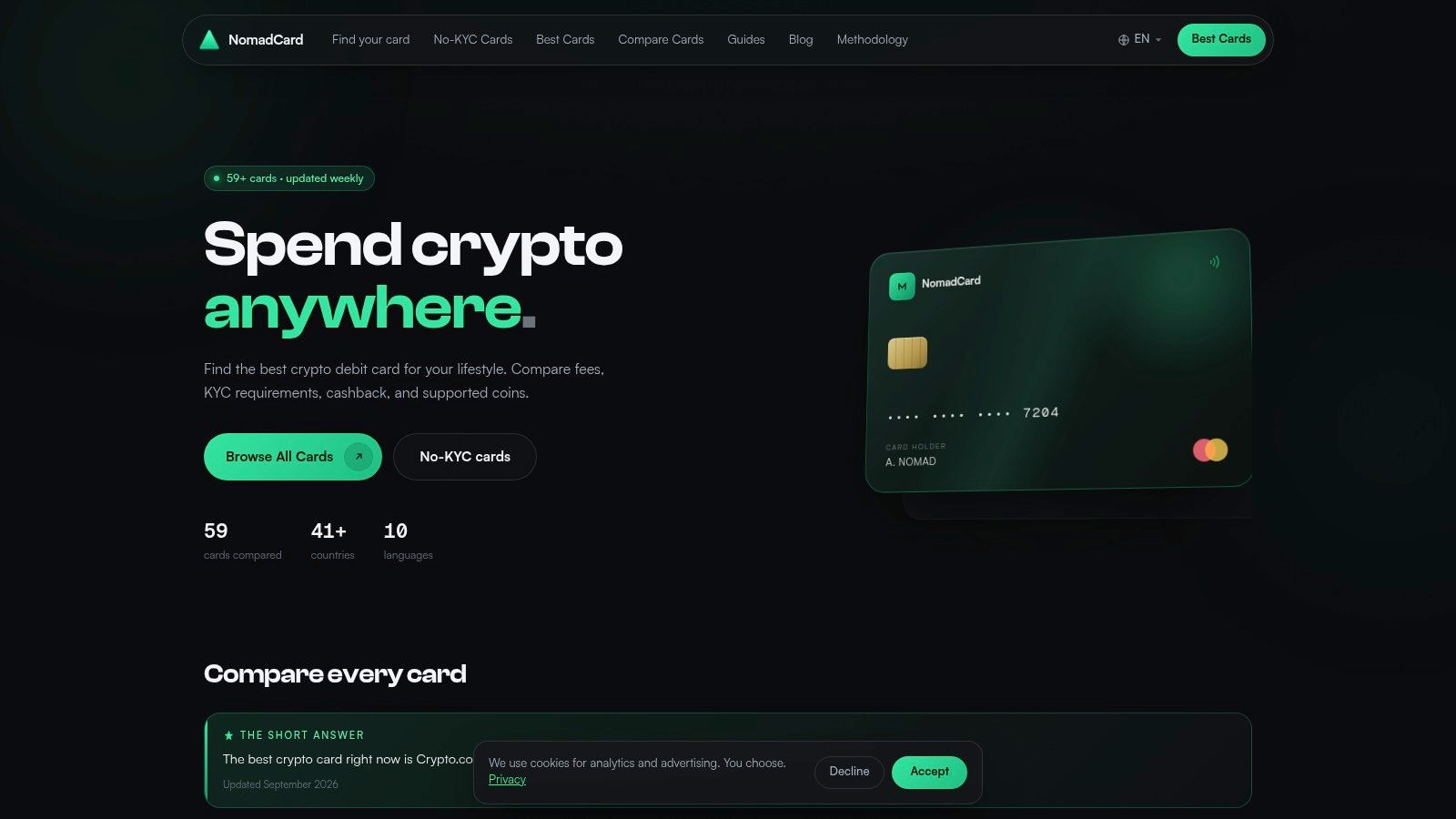
NomadCards is the most useful starting point for readers who don't want to compare only conventional bank accounts. It focuses on crypto-linked debit and credit cards, bringing issuer terms into one research layer so travelers can compare foreign-exchange costs alongside privacy, custody, supported assets, and regional issuance.
The platform's value comes from normalization. Crypto cards can differ sharply in whether funds remain with a custodial provider or move through a self-custodial or on-chain model, whether the account requires no KYC, email-only verification, or full KYC, and whether the card is issued virtually, physically, through Visa, or through Mastercard. NomadCards presents those fields together with supported coins, per-transaction limits, IBAN availability, Apple Pay, Google Pay, and regional rollout notes.
Why crypto travelers need a different comparison
A conventional bank comparison usually asks whether the issuer adds an FX fee and whether it refunds ATM charges. A crypto comparison must also ask who controls the assets, when conversion occurs, what verification is required, and where the card can be issued. A card that looks attractive on cashback may be a poor fit for someone who prioritizes self-custody or limited identity disclosure.
NomadCards offers an interactive finder, standardized card profiles, ranked lists, regional availability notes, and weekly-refreshed composite scores covering fees, privacy, trust, community sentiment, and rewards. Its methodology documentation and advertiser disclosure help users judge how recommendations are produced, while disclosed affiliate links explain how the no-subscription service is monetized.
Practical rule: Treat a crypto card's FX fee, custody model, KYC level, supported assets, and issuing region as one decision, not five separate footnotes.
For travelers, the crypto card travel guide is a useful companion to the comparison pages. Use NomadCards to narrow the field, then verify the issuer's current fee schedule, conversion rules, ATM terms, card availability, and legal disclosures before applying. It's a comparison engine, not a substitute for the issuing institution's contract.
2. Charles Schwab Bank High Yield Investor Checking
Charles Schwab is the strongest conventional choice when cash withdrawals abroad are central to your travel pattern. High Yield Investor Checking combines no foreign transaction fees on debit purchases with worldwide ATM surcharge reimbursement, which addresses the cost that many zero-FTF comparisons leave out.
The account has no monthly fee or minimum balance requirement to open, and currency conversion uses Visa rates. That combination makes the product particularly practical in destinations where cash remains important or where local ATM operators routinely add their own charge. Schwab's online-first structure is the main operational trade-off, since travelers shouldn't expect ordinary branch cash deposits.
Where Schwab earns its ranking
A card purchase and an ATM withdrawal create different cost risks. Schwab handles the issuer-side foreign transaction fee and reimburses ATM surcharges worldwide, but it doesn't make dynamic currency conversion harmless. If an ATM or merchant offers to convert the transaction into U.S. dollars, accepting that option can replace the card network's conversion process with the operator's rate.
- Best for cash-heavy travel: Worldwide ATM-fee reimbursement protects the use case most likely to generate surprise charges.
- Best for predictable conversion: Visa's network rate gives the account a clear baseline when you choose local currency.
- Main limitation: DCC charges aren't rebated, and the account doesn't provide branch-based cash access.
Schwab's checking account page should be your final reference for current eligibility and reimbursement terms. Schwab is less compelling for someone who rarely withdraws cash and mainly wants the quickest app-based account, but it remains difficult to beat when ATM protection is the deciding variable. For a broader view of fee categories across crypto products, compare the crypto card fee guide.
3. Capital One 360 Checking
Capital One 360 Checking takes a simpler route. Its debit card doesn't add foreign transaction fees on 360 Checking debit transactions, and the account has no monthly fee or minimum balance requirement. The product also provides a large domestic fee-free ATM network through Allpoint, MoneyPass, and Capital One, which is useful before departure even though it doesn't solve every overseas cash problem.
The account's mobile tools suit travelers who want routine account management in an app. The weakness appears at the foreign ATM. Capital One doesn't reimburse third-party operator fees, so a card can avoid an issuer surcharge while the ATM owner still charges you.
The network question matters
Some Capital One debit cards are being migrated from Mastercard to Discover. That change can affect international merchant and ATM acceptance, so the logo printed on your specific card matters more than the bank's general reputation. Travelers should carry another payment method rather than assume that domestic ATM availability translates directly into overseas coverage.
A zero foreign transaction fee protects the purchase price. It doesn't guarantee that every foreign terminal will accept the card or that every ATM fee will disappear.
Capital One's 360 Checking information is the appropriate place to confirm the card network and current terms. Capital One ranks above products with more complicated access requirements because the core account is straightforward, but it ranks below Schwab and Fidelity for travelers who expect to withdraw cash frequently. It's best suited to card-first travelers who can carry a backup for acceptance gaps and who prefer simple domestic banking alongside low-cost foreign purchases.
4. Fidelity Cash Management Account
Fidelity Cash Management Account is a strong alternative to Schwab for travelers who are comfortable with an investment-firm account structure. The Visa debit card charges no foreign transaction fees on purchases and provides worldwide ATM fee reimbursement, giving it the same important two-part protection that frequent international travelers seek.
The account also supports bill pay and mobile check deposit, with no monthly fee or minimum balance requirement in the supplied product description. Those features make it more than a travel wallet. You can use it as a cash-management hub while keeping the debit card available for purchases and withdrawals overseas.
A good fit for investment-oriented households
Fidelity's account structure may feel less familiar than ordinary checking. That isn't necessarily a disadvantage, but it changes the setup experience and the way users think about their everyday balance. Travelers who already use Fidelity may find the arrangement intuitive, while someone seeking a standalone banking app may prefer Capital One or Chime.
The cost advantage depends on using the card correctly. Choose the local currency at the merchant or ATM so Visa handles the conversion. If you accept DCC, the transaction can use the operator's exchange rate instead, and Fidelity's ATM reimbursement doesn't turn an unfavorable conversion into a favorable one.
- Cash access: Worldwide ATM reimbursement is the feature that separates Fidelity from simpler zero-FTF cards.
- Account tools: Bill pay and mobile check deposit support ongoing household use.
- Caveat: The brokerage-style structure isn't ideal for every banking customer.
Review the current terms through Fidelity's Cash Management Account page. Fidelity's position is especially strong for travelers who value ATM protection but don't need Schwab's particular brokerage relationship. The two products should be compared on account experience and existing relationships, not only on the headline fee.
5. Betterment Checking
Betterment Checking is distinctive because its advertised economics address both the transaction and withdrawal sides of foreign spending. The account reimburses ATM fees worldwide and reimburses Visa's 1% foreign transaction assessment, effectively reducing those stated costs to net zero when the relevant reimbursement terms apply.
That makes Betterment more than a generic “no foreign transaction fee” card. The issuer's structure matters because a card can advertise no foreign transaction fee while still passing through a network assessment or leaving the customer exposed to an ATM operator charge. Betterment attempts to handle both layers through reimbursement.
The trade-off is simplicity versus yield
Betterment Checking is app-first, supports Apple Pay and Google Pay, and offers joint accounts. It has no overdraft or recurring account fees, which helps users who want a straightforward travel account without a complicated branch relationship. The checking balance doesn't earn interest, however, so the product may be less attractive as a long-term home for idle cash.
Availability is also limited to the United States, and customers need to be comfortable with a bank-partner model connected to an investment app. As with the other cards, DCC should be declined. Reimbursement of a stated Visa assessment doesn't give you control over a merchant's independently offered currency conversion.
Betterment's Checking details deserve a careful review before enrollment, particularly for reimbursement timing, eligible transactions, and international use. Betterment fits travelers who want net foreign-cost protection inside an app-led experience. It's less suitable for someone who values interest on checking balances or prefers a traditional bank interface.
6. Chime Checking
Chime is the easiest fit for travelers who mainly pay by card and want a fee-light checking account. Its Visa debit card doesn't charge foreign transaction fees, supports international use where Visa is accepted, and can be managed through the app. The account also has no monthly fees and offers a broad domestic fee-free ATM network through Allpoint.
The ranking drops when cash becomes part of the itinerary. Chime doesn't reimburse foreign ATM operator fees or out-of-network fees abroad, so the customer may still pay at the terminal even when the issuer adds no foreign transaction fee. That distinction is important for travelers visiting places where cash withdrawals are frequent or where local ATM access is concentrated among fee-charging machines.
Simple setup, weaker cash protection
Chime's appeal is operational rather than feature-heavy. It suits a traveler who wants an accessible Visa card, plans to make purchases directly, and can use another account when cash costs become unreasonable. Some countries are excluded, and international availability should be enabled and checked in the app before departure.
- Best use: Everyday overseas purchases where Visa is accepted.
- Avoid as a sole card: Trips that depend heavily on foreign cash withdrawals.
- Risk control: Carry a second card with a different issuer and network.
Check Chime's official site for current country restrictions and international-use instructions. Chime isn't a poor choice, but its zero-FTF label answers only the purchase-fee question. Schwab, Fidelity, and Betterment rank higher because they address more of the total cash-withdrawal cost.
7. HSBC Premier Checking and Premier Debit Mastercard
HSBC Premier is the specialist choice for customers who want international relationship banking, not merely a cheap travel debit card. Qualifying Premier customers receive no foreign transaction fee on debit purchases, while the broader HSBC network and global-view features can help households managing accounts and transfers across borders.
That value depends on eligibility. Premier requirements can include minimum balances or qualifying relationships, and fees may apply if those conditions aren't met. The account therefore makes more sense for a globally mobile family, expatriate household, or high-balance customer who can use the relationship benefits than for a casual traveler opening an account solely to avoid FX charges.
Global support doesn't remove local ATM costs
HSBC offers broad global ATM access and cross-border banking support, but ATM operator fees may still apply. Acceptance and exchange-rate outcomes can vary by market, so users should confirm the exact terms for the destination rather than assume that international presence means universal fee-free cash access.
The product's advantage is coordination. If you already need international transfers, global account visibility, or relationship support, Premier may justify its conditions. If your only goal is inexpensive travel spending, an account with worldwide ATM reimbursement is usually more directly aligned with the cost problem.
Read HSBC USA's Premier Checking information before applying, paying particular attention to eligibility and account fees. Digital nomads should also compare the wider card options for digital nomads, especially when their banking needs span multiple countries and include crypto-linked income or spending.
Top 7 No-Foreign-Transaction-Fee Debit Cards Comparison
| Product | Setup complexity 🔄 | Requirements 💡 | Expected outcomes ⭐📊 | Ideal use cases ⚡ | Key advantages ⭐ |
|---|---|---|---|---|---|
| NomadCards | Low 🔄, web platform, no install | None; browser access; optional account 💡 | Fast, like‑for‑like crypto‑card comparisons; weekly composite scores ⭐📊 | Travelers, rewards optimizers, privacy/DeFi users ⚡ | Comprehensive normalized data; transparent methodology; non‑custodial coverage ⭐ |
| Charles Schwab Bank, High Yield Investor Checking (Visa) | Moderate 🔄, brokerage + checking setup | ID/SSN; linkage to brokerage account; online application 💡 | No foreign transaction fees; unlimited global ATM fee rebates; predictable cash access ⭐📊 | Frequent international ATM users and travelers ⚡ | Unlimited ATM rebates; no monthly fees; Visa conversion rates ⭐ |
| Capital One 360 Checking (Debit) | Low 🔄, online account opening | ID/SSN; online sign‑up; no minimums 💡 | No foreign transaction fees on debit; good domestic ATM access; limited ATM reimbursement ⭐📊 | U.S. travelers needing broad domestic ATM access and simple abroad spending ⚡ | Large fee‑free ATM network; no monthly fees; user‑friendly app ⭐ |
| Fidelity Cash Management Account (Visa debit) | Moderate 🔄, brokerage‑style setup | ID/SSN; brokerage/cash management account setup 💡 | No foreign transaction fees; global ATM fee reimbursement; bill pay/mobile deposit ⭐📊 | Travelers who want ATM rebates plus brokerage features ⚡ | Universal ATM rebates; clear disclosures; integrated cash management ⭐ |
| Betterment Checking (Visa, issued by nbkc bank) | Low 🔄, app‑first setup | ID/SSN; app sign‑up; U.S. residency required 💡 | Reimburses ATM fees and Visa 1% assessment → effectively net $0 foreign cost ⭐📊 | App‑centric users seeking true zero foreign transaction cost ⚡ | Net‑$0 foreign cost (ATM + Visa fee reimbursements); simple UX ⭐ |
| Chime Checking (Visa debit) | Low 🔄, fast online/app setup | ID/SSN; app sign‑up; U.S. residency 💡 | No foreign transaction fees on purchases; no third‑party ATM refunds ⭐📊 | Casual travelers who mainly pay by card and want easy setup ⚡ | $0 foreign transaction fee; large domestic ATM network; simple onboarding ⭐ |
| HSBC Premier Checking + Premier Debit Mastercard (HSBC USA) | High 🔄, relationship eligibility & documentation | ID/SSN; qualifying balances or relationships; possible fees if unmet 💡 | No foreign transaction fees for qualifying Premier customers; broad international support ⭐📊 | Globally mobile households, expatriates, and high‑balance customers ⚡ | Extensive international presence; cross‑border services and global transfers ⭐ |
Choose by Your Biggest Travel Cost
Start with the transaction you expect to make most often. If you'll withdraw cash regularly, Charles Schwab and Fidelity are the strongest choices because worldwide ATM-fee reimbursement protects you from a cost that a purchase-only zero-FTF promise doesn't cover. Schwab is especially attractive for travelers who want a conventional checking relationship attached to a brokerage account, while Fidelity fits customers who prefer its cash-management ecosystem.
Choose Betterment when the important distinction is the net cost after reimbursement of Visa's stated assessment and worldwide ATM fees. It offers a useful middle ground for app-first customers who want broad reimbursement without a traditional branch model. Capital One 360 and Chime make more sense when simple, fee-light checking and low-cost card purchases matter more than foreign cash protection. Capital One deserves a backup card because Discover branding can affect acceptance in some destinations, while Chime's lack of foreign ATM reimbursement makes cash planning essential.
HSBC Premier is a relationship decision. Its international support can justify the eligibility requirements for globally mobile households, but it isn't automatically the cheapest option for an occasional traveler. Confirm whether you can maintain the required relationship before treating the debit card's foreign transaction policy as a benefit.
Use local currency whenever a merchant or ATM offers DCC. Declining the conversion keeps the transaction with the card network, while accepting DCC can expose you to the operator's exchange rate. Also confirm the destination, network logo, ATM policy, account eligibility, and current issuer disclosures before departure, then carry a backup card from another network or issuer.
Crypto users need another layer of diligence. Compare FX costs, KYC level, custody model, supported assets, network, regional issuance, virtual or physical availability, and spending limits on NomadCards. Cashback alone can't tell you whether a card gives up self-custody, requires full identity verification, or is available in your country.
NomadCards consolidates crypto-linked card terms so you can compare foreign-exchange costs, KYC, custody, supported assets, networks, rewards, and regional availability in one place. Visit NomadCards to filter the alternatives, review the methodology and disclosures, and verify the issuer's current terms before choosing a travel card.