Ask which crypto card pays best and you'll hear the same answer. Take the one with the highest percentage. That advice fails more often than it works, because the percentage is the one number an issuer controls completely and the one number you can't spend.
The market behind those numbers is large enough to matter. DataIntelo values the global crypto credit card market at $3.47 billion in 2025 and puts cashback rewards at 35.2% of it, per its crypto credit card market report. Cashback is the product now. The rate is the pitch.
Crypto credit card cashback adds a layer that fiat rewards never carried. The reward arrives in an asset whose price moves, on terms that can include staking tiers, monthly caps, foreign-exchange charges and conversion spreads. Two cards advertising 3% can finish a year more than a full percentage point apart in what the holder keeps.
So treat this as a set of calculations rather than a rate list. Every card gets the same treatment: the advertised rate, what it costs to hold, what it costs to spend abroad, what it costs to convert, and what survives. The number that matters is realized net cashback as a percentage of annual spend.
Table of Contents
- Why the Headline Cashback Rate Misleads
- Headline Cashback Rates for Leading Crypto Cards
- Turning a Headline Rate Into Realized Cashback
- Reward Conditions That Erode the Headline Rate
- Tax Records Every Crypto Cashback Purchase Creates
- Who Bears the Loss When Something Goes Wrong
- Regional Availability and Card Terms by Country
- Choose and Confirm a Card for Your Spending Profile
Why the Headline Cashback Rate Misleads
An advertised percentage describes a rate, not money. What a holder keeps depends on the currency the reward is paid in, the fees attached to earning and converting it, the cap on how much of it can be earned, and the gap between the reward's paper value and its cash value. Those four variables differ more between crypto programs than between conventional cards.
Cashback is already mainstream, which sets the benchmark crypto cards are judged against. The Consumer Financial Protection Bureau market report cited in an analysis of crypto card cashback programs estimated that consumers earned $47.5 billion in rewards from general-purpose credit cards in 2024, including $16.6 billion in cashback, and that the share of general-purpose card accounts offering cash rewards climbed from 28% in 2015 to 36% in 2024. Crypto cards are competing inside that economy, not inventing a new one.
What changes is the reward itself. A fiat rebate has a stable face value the day it posts. A crypto reward holds only whatever price it carries on the day you sell. Crypto programs also add conditions a conventional card never needed: holding a balance, staking tokens, paying a subscription, or accepting a rate that applies to categories rather than to all spending.
The comparison that matters: a fiat rebate keeps its face value from the day it posts. A crypto reward keeps only whatever its price is when you convert it.
That's why the same 3% printed on two cards can be worth very different amounts, and why the difference rarely appears in the marketing. It appears in the fee schedule, the reward terms and the payout currency.
The test applied to every card below is one question. After annual fees, FX charges, conversion spread, staking lock-up and reward caps, what annual percentage return does this card pay on the money I spend? A rate that can't survive that subtraction is a rate you're paying for.
Headline Cashback Rates for Leading Crypto Cards
The largest advertised percentage does not necessarily deliver the most cashback. A fair comparison puts each rate beside the cost of spending abroad, then translates both into dollars earned or lost on the same annual spend.
| Card | Headline cashback | FX charge |
|---|---|---|
| Crypto.com Visa | 5% | 2% |
| Coinbase Card | 4% | No FX fee |
| Gnosis Pay | 2% | Varies by currency pair |
| Krak Card (US) | Up to 2% | Varies by currency pair |
| MetaMask Card | 0% | No FX fee |
The table gives headline figures, not a universal net return. FX charges matter only on foreign-currency spending, while the cashback rate may depend on conditions that change what a particular cardholder earns.
What the Two Columns Do
For every $100 spent abroad, a 2% FX charge costs $2. At the advertised 5% rate, Crypto.com Visa would return $5 in cashback on that spend, leaving $3 before other costs or reward conditions. That simple subtraction shows why the headline rate alone can overstate the value of foreign purchases.
At $2,000 in foreign-currency spending, a 2% charge totals $40. The Coinbase Card's listed zero FX fee avoids that specific cost, but its advertised 4% still needs to be assessed against the reward currency and any conditions attached to the rate.
Gnosis Pay's 2% cashback and Krak Card's rate of up to 2% are not enough to calculate a single net figure when the FX charge varies by currency pair. The difference matters to people who spend across currencies: the same headline rate can produce different results after FX costs.
MetaMask Card offers no cashback, so there is no reward to offset fees. With no FX fee listed, its comparison rests on the value a cardholder places on those terms, rather than on a cashback percentage.
Use the FX column to estimate the cost of foreign spending, then compare the reward you qualify for against that amount. The headline rate is a starting point, not the amount you keep.
Turning a Headline Rate Into Realized Cashback
A 3% reward is hard to fund, and the arithmetic of who pays for it explains every strange term in a crypto card's fee schedule.
The Federal Reserve's analysis of interchange reports typical U.S. Visa and Mastercard credit card interchange of roughly 1.5% to 2.0% of transaction value, against about 1.2% for signature debit, according to the Federal Reserve interchange study. At 2% interchange, a 3% reward leaves a minimum one-percentage-point gap before processing, fraud, custody, conversion and support costs are paid.
Where the Gap Gets Filled
Issuers close that gap with annual or subscription fees, a spread on crypto-to-fiat conversion, foreign-exchange charges, partner-funded rewards, staking or lending economics, token issuance, or promotional subsidies. Every one of those appears somewhere in the terms, and each one comes out of the reward you thought you were earning.
The flowchart below traces that funding path from interchange through to the reward that reaches the holder.
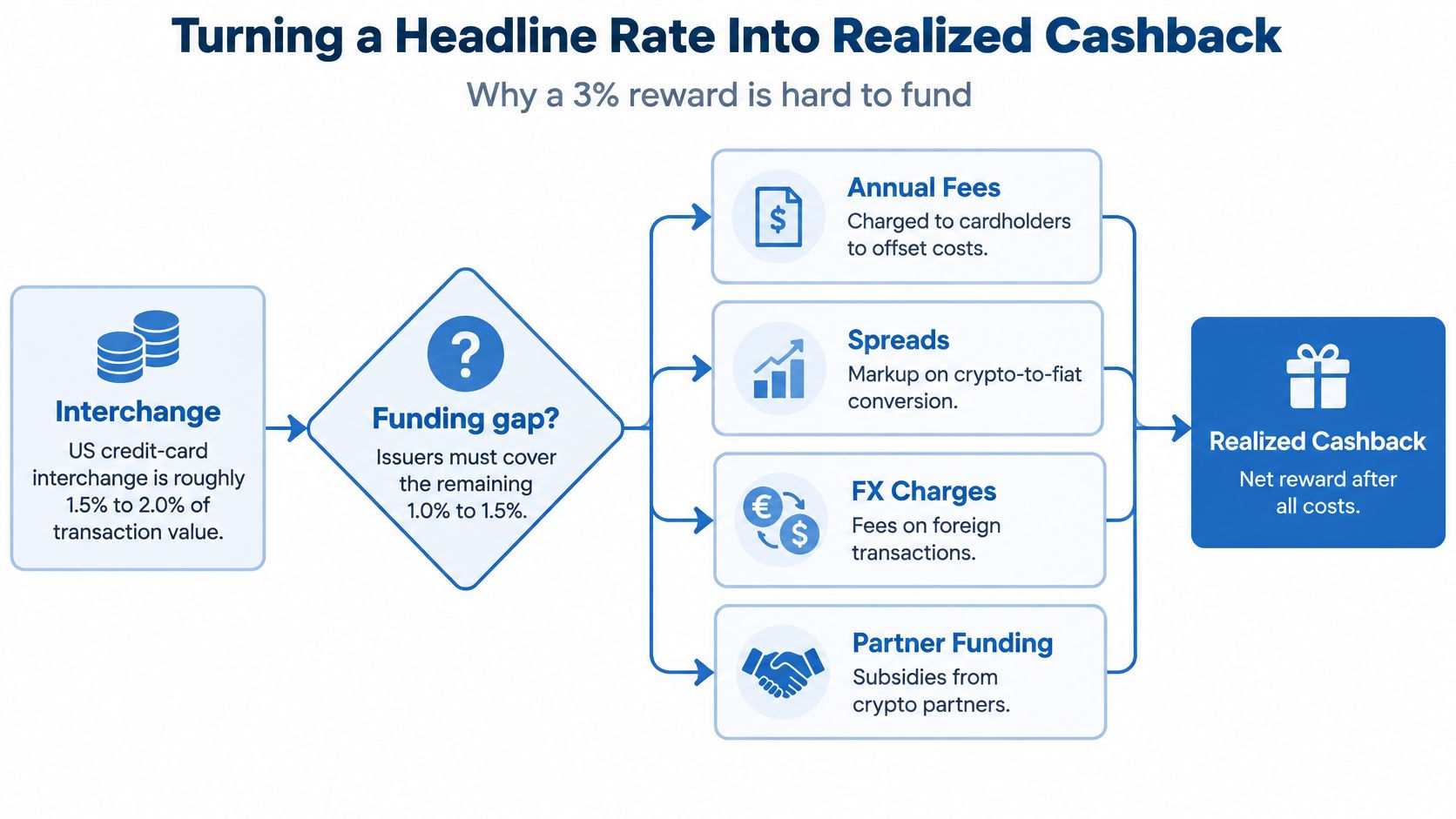
The only comparable figure: cashback received minus every fee and spread, divided by annual spend. Anything quoted before that subtraction is a marketing number.
Seven Steps From Headline Rate to Realized Rate
- Total your annual spend by currency. Split domestic from foreign-currency spending, because only the foreign portion meets the FX charge. You end with two totals, not one.
- Apply the headline rate inside the cap. Where a card caps rewards monthly or annually, apply the high rate only up to the ceiling and the base rate beyond it. That gives gross cashback before costs.
- Subtract the annual fee. A $150 fee against $30,000 of spend costs half a percentage point before anything else happens. Below about $10,000 of spend, that same fee costs a point and a half.
- Subtract FX markup on foreign spend. At 1% on $5,000 of overseas spending, the charge is $50, and it applies whether or not the reward posts.
- Subtract the conversion spread and withdrawal charges. Reward paid in a token you eventually sell carries a cost on the way out. At 0.5% on $30,000 of crypto-denominated spending, that's $150.
- Subtract the cost of any mandatory staking. Locked capital has an opportunity cost even when the token price doesn't move, and the next section prices it. Cards with no staking requirement enter zero here.
- Divide by annual spend. Cashback minus every cost, divided by the total you spent, is the realized rate. That single figure compares across programs.
Run those steps against a 4% card with $30,000 of annual spend and the result lands well below the headline.
| Line item | Illustrative amount | Effect on reward |
|---|---|---|
| Gross cashback at 4% on $30,000 | $1,200 | +$1,200 |
| Annual fee | $150 | -$150 |
| FX markup at 1% on $5,000 foreign spend | $50 | -$50 |
| Conversion spread at 0.5% on $30,000 spent in crypto | $150 | -$150 |
| Realized net cashback | $850 | 2.8% of annual spend |
Capping changes the ranking more than the headline rate does. A capped 5% category reward stops earning at its ceiling and falls to a base rate on everything past it. An uncapped 1% keeps paying on every dollar. Once spending passes the ceiling, the uncapped card closes the gap and then overtakes, and the crossover usually arrives sooner than holders expect.
If you'd rather see the mechanics demonstrated than read them, the walkthrough below covers the same funding logic in video form.
Keep one number per card: realized net cashback as a percentage of annual spend. It's the only figure that survives a comparison across issuers, currencies and tiers.
Reward Conditions That Erode the Headline Rate
A high cashback percentage can still produce a low return on annual spend. The gap comes from conditions attached to the reward: paid tiers, staking, caps, payout currency and vesting. Each changes how much of the advertised rate reaches your account, and when.
Some top reward tiers require a substantial balance or a paid plan. Treat the capital tied up in staking as part of the cost: it may be unavailable for other uses, and its value can fall if the token price drops. The headline rate alone does not show that trade-off.
The Break-Even Question for a Paid Tier
Suppose a paid tier costs $120 a year and raises cashback from 1.5% to 3%. The extra 1.5 percentage points cover the fee at $8,000 of annual card spend: $120 divided by 0.015. Below that spend, the free tier returns more after the fee. Recalculate if your spending changes.
Payout Currency Decides More Than the Rate
A 4% reward paid in a platform token loses value as the token price falls. It drops below a 2% fiat or stablecoin rebate only if the token loses more than half its value before you sell. Stablecoins are designed to track a value, often the dollar, but their price and redemption terms still warrant checking. A platform token adds market-price risk, and reward eligibility or conversion terms may also change.
Caps, Vesting and Timing
A high rate may apply only up to a monthly or annual spending cap. After you reach it, purchases may earn a lower base rate or nothing. Compare the total reward across your expected annual spend, not just the rate on the first eligible purchases.
Vesting changes the value you can realize. A reward available for sale when it posts can be converted promptly; one locked for a period remains exposed to price changes until it becomes accessible. Include that waiting period when comparing net cashback per dollar of annual spend.
If reaching the top rate requires locking capital, account for the lock-up before valuing the reward.
The hidden fees crypto cardholders may pay can affect the same calculation. Check each card for:
- Reward caps: the ceiling and the rate, if any, above it.
- Required balance: minimum holdings, staking and lock-up terms.
- Paid-tier economics: the annual fee divided by the extra cashback rate, giving the break-even spend.
- Payout currency: fiat, stablecoin, platform token or another crypto asset.
- Vesting period: how long rewards are unavailable for sale.
Tax Records Every Crypto Cashback Purchase Creates
For a US taxpayer, recordkeeping is a performance cost, and it lands on every purchase.
The IRS treats digital assets as property, so selling, exchanging or otherwise disposing of them generally requires calculating gain or loss from the asset's adjusted basis and reporting the transaction, including on Form 8949 and Schedule D where applicable, as set out in the IRS digital asset transaction FAQ. A card that sells BTC or ETH at authorization turns a coffee into a disposal. Four hundred purchases in a year become four hundred reportable events, each with its own basis and holding period.
Cashback paid in crypto is a separate matter from the spending event. The IRS states that digital asset income must be reported, and how it's characterized depends on the facts and the transaction. The practical consequence is that a card's headline rate should sit next to its settlement mechanics, not in isolation.
The Fields to Record for Every Transaction
Build the spreadsheet before the first purchase, because reconstructing a year of disposals afterwards is the expensive part.
- Quantity disposed: the exact amount of each asset sold at authorization.
- USD fair-market value: the price at the moment of spending, not at month end.
- Acquisition basis: what you originally paid for those units.
- Holding period: the acquisition date, which decides short-term or long-term treatment.
- Fees paid: network, conversion and card charges, itemized separately.
- Transaction identifier: the wallet or exchange reference that ties the record to a statement.
Then ask two questions of the issuer. Does it supply cost-basis records, and can rewards be sold immediately or do they vest? A card that exports clean basis data saves hours; a card that doesn't pushes the work onto you at filing time. Reconciling a card export against your own log is the same discipline as automating your credit card bookkeeping, applied to an asset that moves in price between purchase and payment.
The benchmark to carry into comparisons is realized net cashback after conversion spread and an estimate of the tax-administration cost. Nominal tokens credited are not the reward. Our guide to how crypto card rewards are taxed covers the reporting side in more depth.
None of this is tax advice. It describes the US position, and other jurisdictions treat disposals, rewards and reporting differently. Confirm your own obligations with a qualified adviser before you rely on a card's structure.
Who Bears the Loss When Something Goes Wrong
A merchant charges you twice for a $600 order and refuses the refund. On a conventional card, the network dispute process decides who absorbs that $600. On a stablecoin transfer settled on-chain, the funds have already moved, and nothing in the payment itself pulls them back.
Set the loss against the headline rate. If both charges post, 4% cashback on $1,200 is $48, or 4 cents per dollar. Leave the duplicate $600 unrecovered and the cash result is a $600 loss plus $48 of rewards, or negative $552. Per dollar that ran through the card, realized net cashback is about negative 46 cents, not positive 4 cents. The posted percentage never recorded that.
A purchase processed through a card network can carry chargebacks, dispute resolution and fraud management. A purely on-chain stablecoin payment is push-based and generally final. The printed rate can match in both cases. Only the amount you can still recover decides the net per dollar.
The regulatory gap is the part the rate sheet leaves out. The Consumer Policy Center reports that proposed U.S. stablecoin rules may omit protections associated with ordinary credit and debit cards, including safeguards for unauthorized use, mandatory error-resolution procedures, privacy protections and limits on fees, per its analysis of the GENIUS Act. A card that earns 4% and resolves disputes like a bank transfer produces a different net from a card that earns 4% and resolves them like a card.
Four Failures and Who Absorbs Them
A merchant dispute. A network chargeback usually suspends or reverses the transaction, and the cashback earned on it typically goes with it. On an on-chain payment, the holder carries the extra $600 unless the merchant chooses to refund. The $24 that 4% would have paid on that charge does not offset it.
An account takeover. Card-network fraud rules generally limit a holder's liability for unauthorized use. Where the card spends directly from a self-custody wallet, whoever holds the keys controls the funds. A compromised key puts the loss on the holder, and no reward rate repairs a drained balance.
A failed redemption. Reward programs can freeze, delay or restructure redemptions. The holder's claim sits against the program's terms and its jurisdiction. Fiat cashback has no equivalent step, so a token reward you cannot sell is worth $0 per dollar of spend until it converts.
Issuer insolvency. Rewards held on a platform are a claim on that platform. Cashback already swept to your own account is not. Until the sweep happens, the headline credit is an unsecured promise rather than spendable net.
Checks to Run Before You Apply
Write five answers next to the rate before you treat 4% as 4 cents of realized cashback per dollar of annual spend.
- Dispute pathway: network chargeback, issuer process, or none.
- Custody: who holds the funds between authorization and settlement.
- Redemption and freeze risk: what the terms allow the program to do to your rewards.
- Governing jurisdiction: whose courts and consumer rules apply.
- Reward reversal: whether cashback is clawed back after a chargeback.
With self-custody the holder controls the keys, so a lost key is usually a loss the holder carries alone. Price that exposure into the annual figure. A rate that looks strong on the marketing page can print a negative net the first time a dispute, a key, or a frozen redemption does not come back.
Regional Availability and Card Terms by Country
A card you can't apply for has a realized cashback rate of zero, which is why availability belongs in the comparison rather than at the end of it.
Terms are geographic. The advertised rate, the top staking tier, the FX treatment and the consumer protections all change with the issuing country, and a rate quoted for one market often doesn't travel to another. Run this checklist for each card on your shortlist.
- Confirm the country list on the issuer's own site. Not on a comparison page, and not on a review written for a different market.
- Check whether the advertised rate and the top tier apply where you live. A rate that exists only in one jurisdiction is a different product from the card you're evaluating.
- Record whether the card is US-issued. US tax treatment and proposed US stablecoin rules apply to US taxpayers and US-linked products, and a card issued elsewhere meets a different regime.
- Check your local rules on digital-asset disposals and consumer protection. Where they differ from the US position, the tax and dispute sections above need to be read against your own jurisdiction.
- Write down the verification date next to any fee or rate. Terms move, and a figure without a date is a figure you can't audit later.
Krak Card's listing is US-specific. A holder outside that market can't apply on those terms and needs a program issued in their own country, which is why the same card name can appear with different rates in different regions. Our card availability data records which jurisdictions each program serves.
Terms also shift by tier within a single country, so a shortlist built today needs checking against the issuer's current terms before an application goes in. That step takes ten minutes and protects the calculation you've already done.
Choose and Confirm a Card for Your Spending Profile
The right card follows from the spending, not from the leaderboard. Match your pattern to the feature that matters most and the trade-off you're accepting becomes visible.
| Spending profile | Feature to prioritise | Main trade-off |
|---|---|---|
| Heavy everyday spend, no staking | Uncapped flat rate in fiat or a stablecoin | Lower headline rate |
| Monthly spend above a reward cap | Uncapped 1% reward over a capped 5% reward | Smaller headline figure |
| Frequent foreign-currency spend | No FX fee and a narrow conversion spread | Lower cashback rate |
| Privacy-first holder with low spend | No-KYC or email-only verification | Lower rewards |
| Large balance willing to stake | Top staking tier with a high rate | Lock-up period and token-price risk |
Why Each Profile Points Elsewhere
Heavy everyday spend with no appetite for staking rewards consistency over spectacle. An uncapped flat rate in fiat or a stablecoin pays on every dollar and needs no balance parked anywhere, which usually beats a higher rate that stops at a ceiling.
Spending above a reward cap inverts the ranking entirely. Once the bonus slice is used up, the base rate is what pays, and an uncapped 1% keeps earning where a capped 5% has already stopped.
Frequent foreign spend makes the FX column the deciding one. A no-FX card with a narrow conversion spread can beat a higher headline rate that hands two points back at the border.
Low-spend, privacy-first holders face a different calculation. Lighter verification is worth more to them than a point of cashback, and the realistic goal is spending convenience rather than a return.
A holder with a large balance can reach a top staking tier, but the reward then compensates for lock-up and token-price exposure. That can be a fair trade. It should be a deliberate one.
Four Steps to a Shortlist
- Identify your profile. Use the table above, and be honest about whether you'll stake.
- Run the seven-step calculation on two or three cards. Same spend, same currency split, same conversion assumption for each.
- Check conditions, caps and records against the checklists. Caps, required balance, paid tier, payout currency, vesting, then the protection and recordkeeping questions.
- Confirm current terms on the issuer's site. Rates and tiers differ by country and tier, and the issuer's own documentation is the version that binds.
Sorting a comparison by Best overall, Highest cashback, Lowest fees or Most countries gets you to a shortlist quickly, and our editorial team verifies every published fee across 59 crypto cards against issuer documentation, with the verification date shown on every figure. NomadCards isn't a bank, a card issuer or a financial adviser, so the calculation stays yours to run.
Before you apply: confirm the card is issued in your country, that the tier you qualify for matches the rate you read, and that the FX terms are current.
The headline rate gets you started; your calculated figure gets you the right card. NomadCards lets you compare crypto debit and credit cards side by side on cashback structure, fees, KYC level and regional availability, so you can run the same calculation across every option rather than across a marketing page. Shortlist two or three programs, work each one through the seven steps, then confirm the current terms with the issuer before you apply. Visit NomadCards to start the comparison.