You're about to pay for lunch with a crypto-linked card. Your wallet shows enough money, the terminal looks familiar, and the purchase feels like any other tap. But you're not sure whether the card provider holds your funds, whether you've already authorized future spending, or how you'd recover access if your phone disappeared.
Those questions matter more than the wallet's label. Self custody crypto is a responsibility system, not just an app you install. A useful setup connects control over funds with understandable approvals, dependable backups, workable recovery, and clear limits on what other parties can do.
Table of Contents
- What Control Looks Like in Practice
- How Keys and Signing Work Together
- What Responsibility Moves to You
- Build a Practical Security System
- Apply Security Across Real Use Cases
- Compare Self Custodial Card Spending
- Correct the Biggest Misconceptions
- Make a Safe Custody Decision
What Control Looks Like in Practice
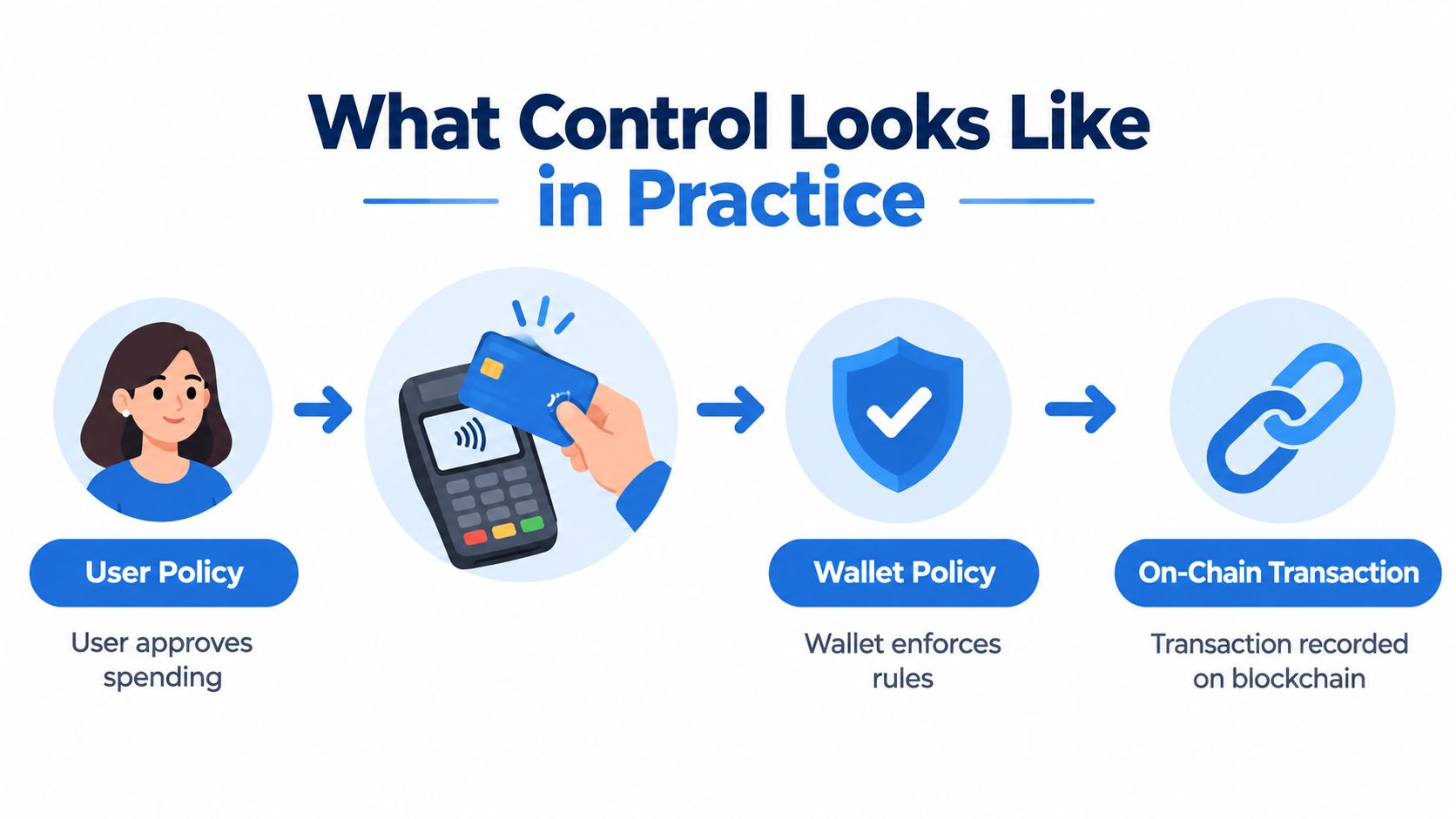
You tap your card at the café. The merchant sees a payment approval, but your side of the purchase may involve a wallet, a spending permission, and a contract that checks whether the payment fits your rules. You might approve spending in advance rather than sign something while standing at the counter.
The important distinction is who has authority to move the assets. With self-custody, you control the private keys or equivalent signing authority rather than asking an exchange to release funds. For card-linked wallets, the relevant questions include whether funds remain in your address and whether payment limits are enforced through wallet policy, as described in Wells Fargo Advisors' discussion of digital-asset custody.
The diagram illustrates a policy-controlled payment path, not a universal design for every crypto card.
Separate ownership from payment access
A useful way to evaluate the café purchase is to distinguish these roles:
- Asset control: Who can authorize movement from the wallet?
- Spending approval: Are you approving this payment, or has an earlier permission delegated that authority?
- Service access: If the card app stops working, can you still access the underlying wallet independently?
A card service can become unavailable without necessarily taking control of your wallet balance. Conversely, seeing funds in a wallet interface doesn't establish that you alone can move them.
Practical rule: Trace authority, not branding. Ask who can spend, who can change the rules, and what still works without the provider.
That distinction also explains why wallet access and card access need separate recovery plans. Replacing a card isn't the same task as restoring signing authority.
How Keys and Signing Work Together
A wallet is better understood as a control panel for signing authority than as a digital purse. The assets aren't sitting inside the phone or hardware device. The device helps you manage the credentials and instructions used to control them.
A house-key analogy helps initially: someone with the right key can open the door. But a recovery phrase changes the analogy. Someone who copies it may be able to recreate your signing capability elsewhere, without taking your original device.
Follow the transaction journey
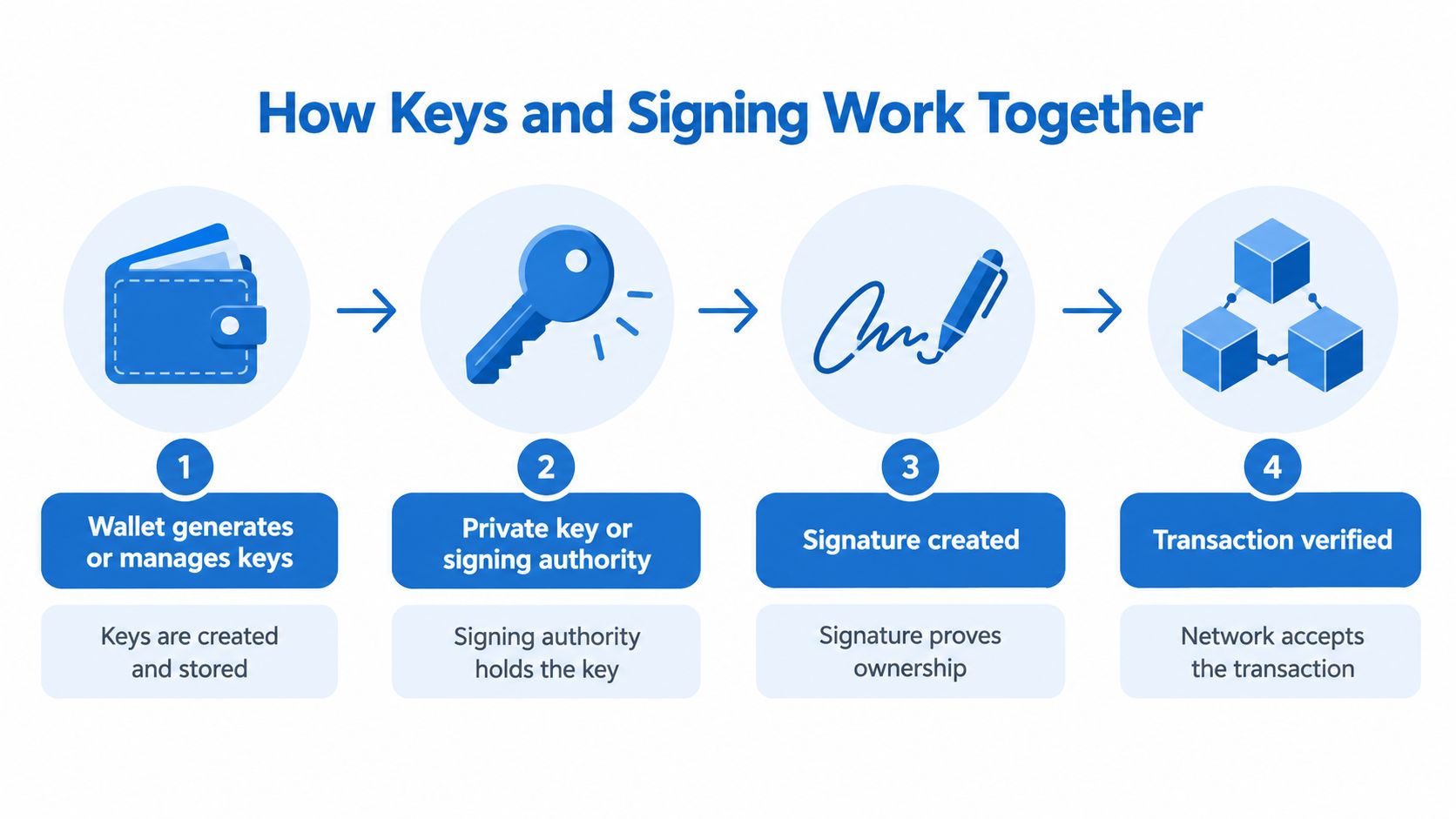
First, the wallet generates or manages cryptographic keys. Next, you prepare an instruction, such as sending an asset to another address. The wallet or signing device then creates a digital signature, which allows the network to check that the instruction carries the required authorization.
Signing and broadcasting are distinct actions. Broadcasting submits the signed instruction to the network; it doesn't, by itself, guarantee acceptance or finality. Once accepted and finalized under the network's rules, an ordinary valid transfer generally can't be reversed by a customer-support agent.
This diagram separates key management from signing and network verification.
Know which object you're protecting
These terms describe different parts of the system:
- Private key: A secret used to create signatures. In a conventional wallet, possession of it is sufficient to authorize transfers.
- Seed phrase: Recovery material from which a compatible wallet can reconstruct keys. It isn't another name for a receiving address.
- Address: An identifier used to receive assets or identify an account. Sharing it doesn't normally grant spending authority.
- Signing device: The phone, computer, or dedicated hardware that produces signatures.
- Smart-contract account: An account whose authorization rules can include more than a conventional private-key signature.
The practical difference becomes clear when a device breaks. Losing the signing device needn't mean losing access if you have a valid, compatible recovery method. Losing both the device and the necessary recovery material is a different problem.
Also distinguish proof of authorization from proof of intent. A network can verify a valid signature without knowing whether you understood the transaction. Your signature may authorize exactly what the transaction specifies, even when that isn't what you thought the screen meant.
What Responsibility Moves to You
Leaving exchange custody changes which failures you must prepare for. You no longer rely on that exchange to approve withdrawals from assets you control independently. Instead, you become responsible for making sure your own signing and recovery arrangements remain usable and uncompromised.
That's a transfer of responsibility, not a promise of safety.
Chainalysis estimated that personal-wallet compromises represented 44% of stolen cryptocurrency value in 2024, compared with 7.3% in 2022, with an estimated $1.5 billion stolen from individuals in 2024. These figures don't establish that self-custody causes theft. They show why individual credentials and authorization processes deserve serious protection.
Replace the exchange's safeguards deliberately
Think of the move as taking over operational jobs rather than merely transferring a balance:
| Responsibility | What you need to establish |
|---|---|
| Key creation | A trustworthy setup process and signing environment |
| Backups | Recovery material that survives device loss |
| Approval review | A way to inspect what you're authorizing |
| Maintenance | Reliable procedures for updates and device replacement |
| Incident response | A plan for suspected credential or permission compromise |
| Continuity | Instructions for access during incapacity or after death |
An exchange account may provide a support-led recovery process. Your wallet may instead depend on material that no support team possesses. Before moving funds, identify which conveniences you're giving up and what replaces each of them.
Judge the whole workflow
Consider a hypothetical user who stores recovery material carefully but approves an unfamiliar contract request while distracted. Their backup discipline doesn't make that approval safe. Another user might reject suspicious transactions consistently but keep their only recovery copy beside the device it backs up.
These are different failures, so they need different controls.
Sound cryptography doesn't compensate for an unread approval or an unusable backup.
Your security plan should therefore cover both unauthorized access and authorized mistakes. Ask whether an attacker could obtain your credentials, but also whether they could persuade you to approve something harmful without obtaining those credentials at all.
Build a Practical Security System
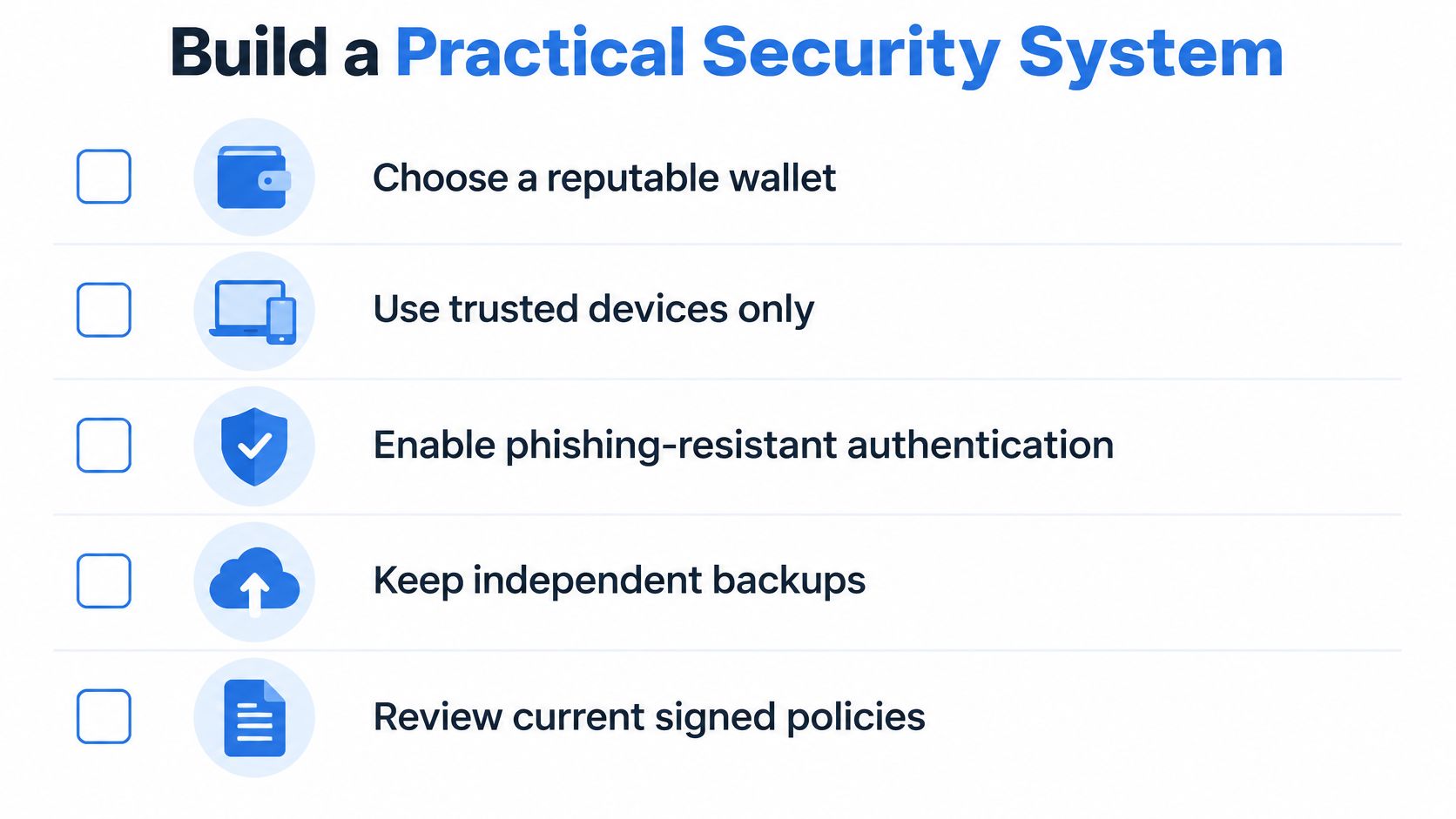
Start with a repeatable routine, not a hardware shopping list. Choose a wallet whose recovery method, transaction prompts, supported assets, and permission controls you can explain in ordinary language. If you can't describe how you'd restore access, postpone moving a material balance.
Use this checklist as a starting point, then adapt it to the wallet's documented security model.
Establish a trustworthy signing environment
Obtain devices through a provenance you can verify. Use current signed firmware through the manufacturer's documented process, and don't assume that a sealed box proves everything inside is trustworthy.
A documented hardware-wallet firmware incident describes intended 128-bit seed entropy being reduced to approximately 40 bits on some models and 72 bits on others, making offline key reconstruction feasible. The lesson is specific: protecting a key inside hardware can't repair weak key generation that happened beforehand.
For a wallet affected by a seed-generation vulnerability, updating firmware alone doesn't replace the vulnerable seed. Follow the documented remediation process, including creating fresh recovery material where required.
Build these habits into routine use:
- Protect supporting accounts: Use phishing-resistant authentication where available for associated email, provider accounts, and recovery services. This doesn't replace wallet-signing security.
- Keep backups independent: Avoid making the same lost device or damaged location responsible for both signing and recovery.
- Inspect transaction details: Check the recipient, asset, network, amount, and requested permissions using trustworthy displays.
- Limit routine exposure: Keep everyday spending separate from holdings that don't need frequent access.
If you're evaluating a messaging-based interface, use the Telegram non-custodial wallet guide to frame questions about signing and recovery. A familiar chat interface isn't evidence of a particular custody model.
Rehearse a calm response
If you suspect compromise, stop using the questionable interface and assess the problem from a trusted environment. Determine whether you're dealing with stolen recovery material, a malicious permission, or an unreliable display before taking further action.
Revoking a permission doesn't repair an exposed seed. Equally, replacing hardware doesn't necessarily cancel permissions previously granted to a contract. For an unfamiliar setup, seek technically competent help without disclosing recovery secrets.
Use the video as supplementary material, then check any procedure against your wallet's current documentation.
Apply Security Across Real Use Cases
A person saving for the long term and someone making frequent payments shouldn't automatically use the same arrangement. Their access needs differ, so the balance between convenience, review, and recovery should differ too.
Long-term holding needs durable access
Consider someone who rarely moves their holdings. Their main operational challenge is keeping recovery usable through device replacement, relocation, and changing family circumstances. They should document the wallet type, necessary recovery components, and restoration procedure without placing every secret in the same document.
The estimate of roughly 20% of bitcoin potentially lost through key loss, cited in the earlier Wells Fargo custody discussion, is an estimate rather than a precise count. Its practical significance is straightforward: safeguarding assets includes preserving access, not just preventing theft.
A sensible rehearsal uses an empty or deliberately limited test setup. The objective is to confirm that the instructions work without exposing the main recovery material to an unnecessary online interaction.
Frequent use needs understandable approvals
An active user has a different problem: repeated interactions with payment interfaces and contracts. Their workflow should make the proposed action readable and provide a clear reason to reject unexpected requests.
- For routine payments: Use an intentionally limited spending wallet rather than exposing long-term holdings to every interaction.
- For contract access: Examine the scope of permission, not just the name of the application requesting it.
- For card funding: Establish whether the purchase uses existing assets, conversion, or another arrangement before relying on the product.
The guide to spending crypto without selling provides a useful starting point for distinguishing payment arrangements. Don't assume that familiar marketing language describes the actual economic transaction.
Higher-value control needs independent safeguards
For material balances, multisignature custody can require a quorum of independently generated keys. The benefit is that compromising a device or manufacturer doesn't, by itself, authorize spending. Independence matters, so avoid recreating a shared failure point by storing all recovery components together.
Smart-contract wallets can add daily spending limits, guardian-based recovery, and policy-based approvals. Those features may contain the consequences of a compromised signer, but they also introduce questions about contract security, upgrade authority, guardians, and integrations.
Choose added complexity only when you can maintain it. A complex arrangement that nobody can recover is not a resilient arrangement.
Compare Self Custodial Card Spending
Self-custodial card spending is an implementation pattern, not proof of control by itself. A card might connect to a user-controlled wallet, draw through a spending contract, or require funds to enter a provider-controlled balance. The checkout experience may look similar across these designs.
Follow a hypothetical purchase from the card authorization request to the source of funds. Identify who approves the request, what existing permission allows it, and where the asset movement occurs. Don't assume every tap requires a fresh on-chain signature or that the merchant receives cryptocurrency.
Custodial and self-custodial card models
| Feature to verify | Custodial implementation | Self-custodial implementation |
|---|---|---|
| Custody | Provider controls the spending balance | Verify that funds remain under user-controlled authority |
| Payment authorization | Provider approves spending under account rules | Check fresh signatures, delegated permissions, and contract rules |
| Limits | Usually administered through provider systems | Establish whether limits are enforced on-chain or only in the app |
| Recovery | Provider-led identity and account recovery | Wallet recovery and card recovery may be separate |
| Asset support | Check eligible balances and conversion terms | Check eligible assets, chains, and contract compatibility |
| KYC | Verify identity requirements and restrictions | Don't infer exemption from the custody label |
| Fees | Inspect funding, conversion, withdrawal, and card charges | Inspect provider charges alongside applicable network costs |
| Regional availability | Confirm issuer eligibility and permitted use | Confirm both card eligibility and wallet integration support |
| Service interruption | Ask how balances can be withdrawn | Ask whether wallet access survives a card-service outage |
The table gives you questions to investigate, not universal product characteristics. Read the issuer's current terms and technical documentation for the program you're considering.
Verify the permission boundary
The most useful evidence explains what the provider cannot do, as well as what it can do. Look for a clear description of the spending address, authorized contracts, administrative powers, and cancellation process.
Ask whether a provider can pause payments, upgrade a contract, or change the mechanism through which spending is approved. A pause affecting card acceptance is different from authority to move your wallet assets. Treat those as separate questions rather than a single judgment about trust.
Before linking a wallet: Establish what remains accessible if the card provider, its app, or its payment integration becomes unavailable.
Use a custodial versus self-custody crypto card comparison to organize the investigation. Then verify the answers against the specific issuer and wallet documentation.
Convenience still matters. A setup that makes every ordinary purchase confusing may encourage rushed approvals or workarounds. Prefer a design whose permission boundaries you can explain and whose routine controls you can follow.
Correct the Biggest Misconceptions
Controlling a token's keys doesn't eliminate the token's economic dependencies. A self-custodied stablecoin can still depend on an issuer, reserves, redemption arrangements, freeze authority, and the network carrying it.
The Swedish central bank's stablecoin risk memo explains that stablecoins lack deposit guarantees and that holders can suffer losses when an issuer can't redeem tokens at par. Key control answers who can authorize a transfer. It doesn't establish what the asset will be worth or whether you can redeem it.
Separate the claims behind the label
Non-custodial branding also doesn't settle questions about delegated activity. When exploring automated strategies, a resource such as copyfomo non-custodial mirroring should prompt scrutiny of permissions, revocation, and execution authority, rather than substitute for it.
Use distinct questions for distinct risks:
- Key risk: Can someone recreate or misuse my signing authority?
- Permission risk: What have I authorized another party or contract to do?
- Asset risk: Who controls redemption, reserves, or freezing?
- Continuity risk: Can the intended person recover access when I can't act?
Hardware addresses only part of this map. As the signing discussion established, keeping keys protected doesn't make every approved instruction safe.
Secrecy isn't an estate plan
A hidden seed phrase may defeat an attacker while also defeating your executor. Resilient ownership requires a controlled way for the right people to act after death or incapacity, without granting premature access.
The estate-planning discussion of crypto operational security highlights recovery designs involving multisignature arrangements, distributed backups, and fiduciary support. Test the operational instructions and obtain jurisdiction-specific legal and tax advice where needed. Don't ask heirs to improvise a custody procedure during a crisis.
Make a Safe Custody Decision
Write down your proposed setup before moving funds:
- Assets and exposure: Identify what you'll hold and what loss you could tolerate.
- Signing environment: Name the devices and approval process you'll use.
- Backup and recovery: Record the method, responsible contacts or guardians, and testing procedure.
- Payment use: Specify what a card or contract may spend and how you'll stop it.
Review the plan for device loss, incapacity, and death. Legal and tax arrangements depend on your jurisdiction and circumstances.
Self custody crypto can reduce exchange dependence and support wallet-linked spending, but the decision is only meaningful when key control, transaction policy, asset dependencies, and recovery work together. Test the arrangement before committing material funds.
NomadCards is an independent comparison website for crypto-linked debit and credit cards, with standardized information on custody models, fees, verification requirements, supported assets, and regional availability. Visit it to shortlist suitable cards, then verify each issuer's spending permissions and recovery arrangements against your custody plan.