You're at checkout with USDC in your wallet, but the merchant wants local currency. A crypto card promises an easy payment, while a wallet transfer promises low fees. Neither promise tells you how much the merchant receives, when the money becomes spendable, or what happens if the purchase goes wrong.
Stablecoin payments use tokens designed to track a reference asset, commonly the dollar, to move value. But the token is only part of the payment. The route between your wallet and the recipient determines custody, conversion costs, settlement timing, and your options for recovering money.
Table of Contents
- Stablecoin Payment Rails Compared at a Glance
- How a Stablecoin Payment Moves From Wallet to Merchant
- How Fast Stablecoin Money Actually Arrives
- Fees Stacked Up and Where the Real Cost Sits
- Merchant Acceptance Options and Their Trade-offs
- Card Spending and Remittances in Practice
- Choosing a Stablecoin Payment Rail Safely
Stablecoin Payment Rails Compared at a Glance
Stablecoin market capitalization reached approximately $317 billion on April 6, 2026, representing growth of more than 50% since early 2025, according to the Federal Reserve.
That scale doesn't make every stablecoin payment equivalent. A payment rail is the route and infrastructure used to deliver value. Paying directly from a wallet, spending through an exchange account, and tapping a crypto-linked card involve different intermediaries.
Stablecoin payment rails compared
| Rail | Who Holds the Funds | Reversibility | Typical Fee Profile | Best Fit |
|---|---|---|---|---|
| Direct on-chain transfer | Sender controls funds until transfer; recipient controls them afterward | No third-party reversal of a finalized transfer | Network fee; wallet service charges may apply | Peer-to-peer transfers and crypto-native merchants |
| Exchange-to-exchange transfer | Exchange custodians, with blockchain transfer between platforms where required | Internal corrections follow exchange policy; finalized withdrawals generally require recipient cooperation | Withdrawal fee plus conversion spread | Moving balances between accounts |
| Custodial processor checkout | Payment processor until merchant settlement | Merchant or processor issues a separate refund | Processing charge plus conversion spread | Merchants wanting fiat payouts |
| Crypto-linked card | Card issuer or wallet provider; self-custodial arrangements can retain user control until spending | Card network dispute rules may apply to the purchase | Conversion spread and applicable card fees | Everyday spending where the card is accepted |
| Bank wire | Sending, intermediary, and receiving banks | Recall request, not guaranteed recovery | Transfer charges plus foreign-exchange margin | Large transfers requiring bank documentation |
Choose the recovery path, not just the interface
A wallet app can make different arrangements look identical. Check whether the displayed balance represents tokens you control through private keys or a claim against a company that holds them.
Likewise, an exchange transfer may be an internal ledger entry rather than a blockchain transaction. That changes which records prove delivery and who can investigate a mistake.
Practical rule: Choose the rail by the consequences of a failed payment, not by how quickly the confirmation screen appears.
For an unfamiliar merchant or a purchase likely to need a refund, a documented dispute process may matter more than immediate finality. For a transfer to your own verified wallet, control and predictable delivery may matter more. Faster doesn't automatically mean safer, and slower doesn't guarantee recovery.
How a Stablecoin Payment Moves From Wallet to Merchant
A processor checkout often combines a blockchain transfer with a separate merchant payout. The shopper can finish their part before the merchant receives money in a bank account.
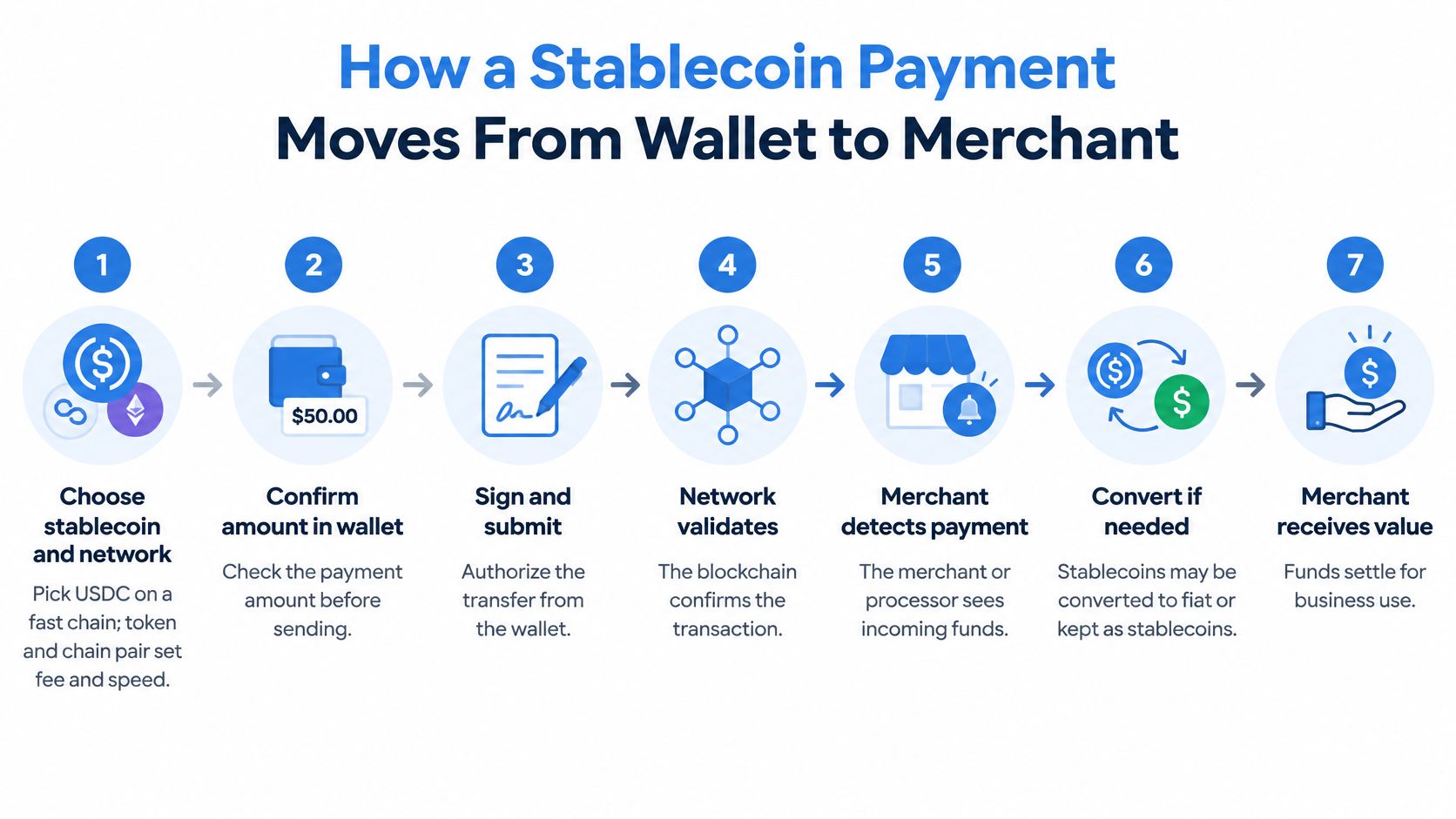
The wallet-to-merchant path looks like this:
Follow the payment instructions precisely
Choose the stablecoin and network. USDC on one blockchain isn't interchangeable at checkout with USDC on another. Match both the token and network to the merchant's instructions. Sending to an unsupported network can leave funds inaccessible or require recovery that the recipient cannot perform.
Confirm the quoted amount. Check the invoice currency, token amount, destination address, and quote expiry. A checkout may lock its conversion rate temporarily. Paying against an expired quote can create an underpayment or an order that needs manual reconciliation.
Sign the transfer in your wallet. A plain token transfer authorizes that payment, not unrestricted access to your remaining balance. Inspect the request carefully: a smart-contract approval is different and may grant ongoing spending permission. Reject a request that doesn't match the intended action.
Broadcast the transaction. The wallet submits the signed instruction to the network, where validators process it. A pending entry isn't proof of successful delivery. Keep enough of the network's fee asset available unless the wallet explicitly sponsors fees.
Wait for confirmation. The merchant or processor accepts the payment once it meets the service's confirmation threshold, so don't treat a submitted transaction as an accepted order.
Credit stablecoins or convert them. A direct-acceptance merchant receives tokens into its wallet; a processor may instead convert the payment into the merchant's accounting currency. The conversion terms determine the amount credited, so the invoice value and eventual payout need reconciliation.
Complete the merchant payout. If the merchant requests bank settlement, the processor sends fiat according to its payout schedule and account conditions. A completed checkout doesn't necessarily mean that bank payout has occurred.
Keep a receipt that proves delivery
Save the transaction hash, network name, destination address, token amount, and merchant order reference. A block explorer can show whether the blockchain transfer succeeded, but it can't prove that a processor credited the correct order.
If a merchant reports missing funds, send both the transaction hash and invoice reference. That gives support staff a way to connect the on-chain transfer with the checkout record without asking you to pay again.
How Fast Stablecoin Money Actually Arrives
According to Visa's introduction for banks and fintechs, on-chain settlement commonly completes in seconds to minutes, compared with roughly one to five business days for traditional cross-border transfers. That comparison describes the settlement leg, not necessarily delivery into a usable bank balance.
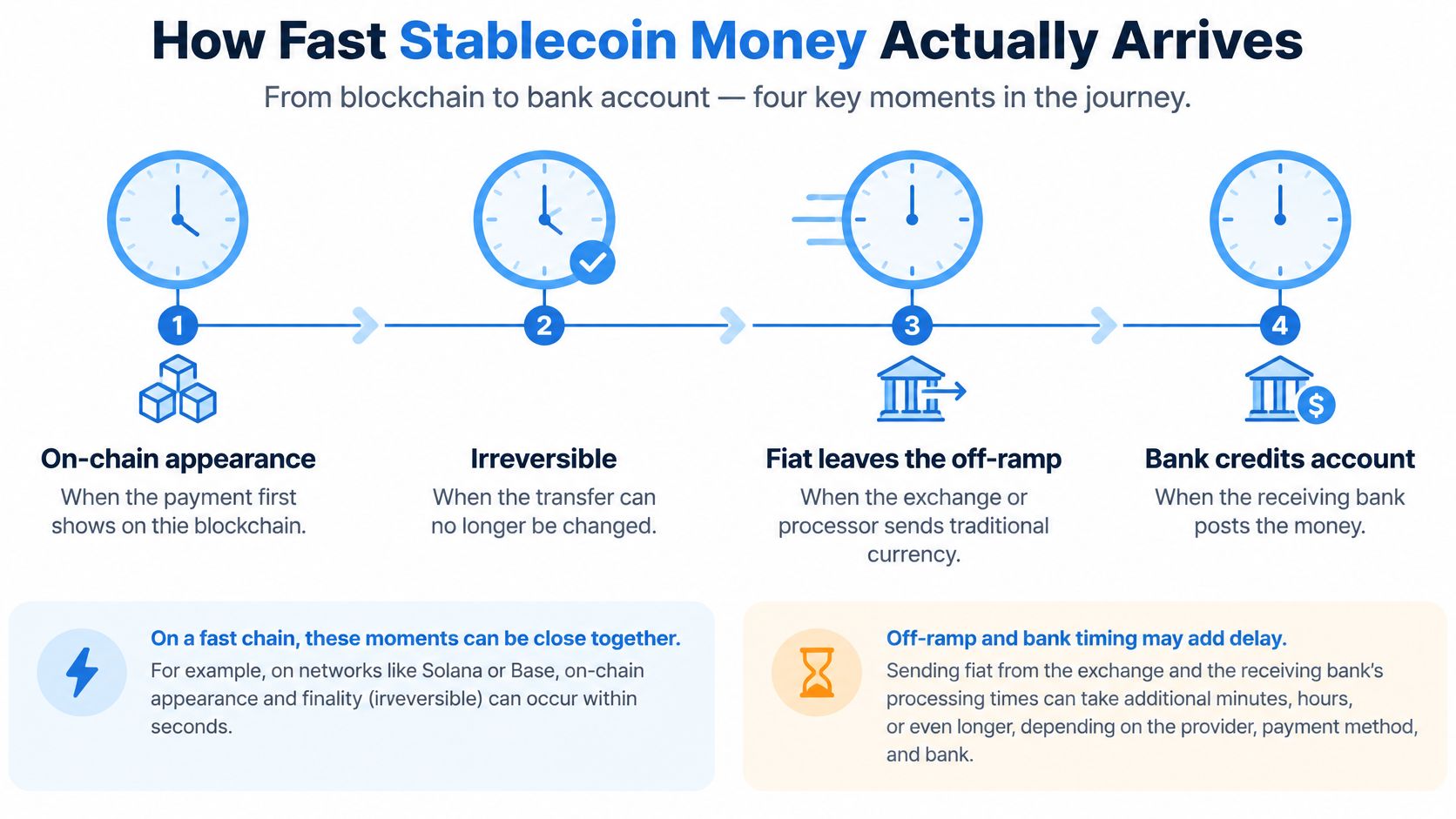
A payment has several distinct timing milestones:
Read each clock separately
- On-chain appearance. The recipient's interface detects the transaction. A visible pending payment may still be unconfirmed.
- Economic finality. The transfer meets the relevant network and provider requirements for being treated as settled. Wallet notifications and processor acceptance thresholds aren't necessarily identical.
- Fiat leaves the off-ramp. The exchange or processor completes conversion and releases a bank payment. Compliance checks, available liquidity, and payout operating hours can delay this stage.
- Bank credits the account. The receiving bank posts the funds and makes them available. The recipient can't spend a bank payout merely because the processor marked it sent.
Follow the money to its usable destination
Say a merchant receives a stablecoin payment early on Saturday. Its wallet detects the transfer promptly, but its chosen off-ramp doesn't process bank payouts over the weekend. The merchant may hold settled tokens while waiting until Monday for the fiat payout process to resume.
If the merchant can pay a supplier directly in the same token, bank availability may be irrelevant. If it needs local currency for payroll, that final bank credit is the meaningful finish line.
The useful question isn't whether the blockchain is fast. It's when the recipient can use the money in the form they need.
Network congestion can extend confirmation time. Separately, a crypto card's quick authorization only tells the merchant that the purchase was approved, not how the provider funds or settles it.
Before relying on a service, obtain its timings for detection, finality, fiat release, and bank availability, including weekend handling and delayed-payment procedures.
Fees Stacked Up and Where the Real Cost Sits
A payment can look cheap at the exact moment it becomes expensive. The wallet sends a token for pennies, the checkout approves quickly, and then the bill arrives through a wide conversion spread, a card charge, or a payout fee on the other side. Speed and cost settle on different ledgers: the chain records the transfer, while the provider, processor, and bank decide what each party keeps.
Some blockchains offer transaction fees as low as a cent, according to Visa's overview of on-chain finance. That figure describes the network leg, not the completed purchase, cash withdrawal, or merchant payout.
Calculate the whole payment
Total payment cost = network fee + wallet or provider fee + conversion spread + card or merchant-processing fee + bridge cost + applicable withdrawal or cash-out charges.
Only include charges incurred, and avoid counting a bundled fee twice. Distinguish your own bill from the combined cost to payer and recipient: a merchant's processing charge may reduce its proceeds without appearing as a separate shopper fee.
Cost components in a stablecoin payment
| Cost Component | Typical Range | Usually Paid By | How to Lower It |
|---|---|---|---|
| Network fee | Chain's current execution charge; congestion can increase it | Sender | Use a supported low-fee network and inspect the wallet estimate |
| Wallet or provider fee | Published transaction, service, or subscription charge | Sender or merchant | Compare the complete fee schedule |
| Conversion spread | Difference between the quoted rate and a reference rate | Sender or merchant | Compare executable quotes for the same amount and currency pair |
| Bridge cost | Route-specific bridge charge, execution fees, and possible swap spread | Sender | Hold funds on the network used for spending |
| Off-ramp withdrawal fee | Provider's charge for the payout method and destination | Recipient or sender | Check the receiving method before converting |
| Card or processing fee | Percentage, fixed charge, or combination set by the agreement | Merchant; some card charges fall on the shopper | Review acquiring terms and cardholder charges separately |
Reduce avoidable costs
Start with network compatibility. A card or processor that supports your token on a different chain can force a bridge or exchange transfer before spending becomes possible. That adds operational risk as well as charges, because value may sit temporarily with an intermediary instead of remaining in your wallet.
Next, compare the amount delivered, not just advertised fees. Request a quote showing what leaves your wallet and what reaches the recipient after conversion. Choose the payout method before funding the transaction, especially when the recipient needs cash rather than tokens. A merchant that can spend USDT directly cares about token arrival; a merchant paying rent in local currency cares about the bank credit after conversion.
Reversibility belongs in the same calculation. A card checkout may have a dispute path, while a confirmed stablecoin transfer usually needs a separate payment back. Crowdfunding offers a clean contrast: workflows built to recover failed crowdfunding payments assume a missed pledge can be retried or chased, while an on-chain send to the wrong destination leaves recovery to the recipient or a manual process. Price the recovery path before you send, not after the receipt looks final.
Merchant Acceptance Options and Their Trade-offs
Retail-sized transaction volume involving USDC, USDT, and PYUSD reached $69.8 billion in 2025, up from $0.5 billion in 2019, according to Visa. That growth makes stablecoin acceptance worth evaluating, but it doesn't establish demand among your own customers.
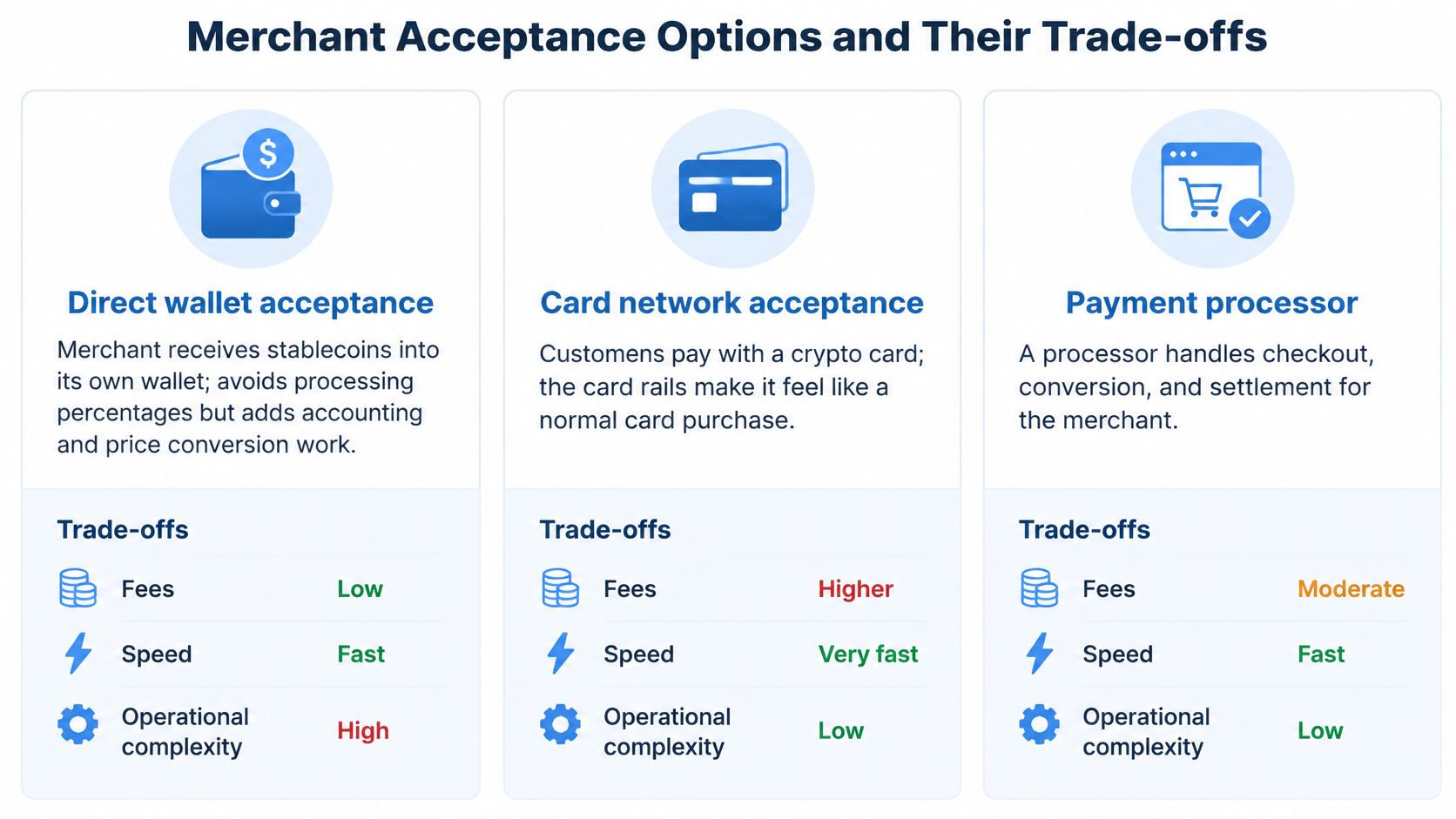
The merchant decision is less about supporting crypto in general and more about choosing which payment operations to own.
Match acceptance to your back office
Direct wallet acceptance gives the merchant responsibility for receiving and managing tokens. Without a checkout processor, there may be no processor percentage, but the business still needs invoice matching, access controls, conversion procedures, and refund records. A shared wallet address alone is a weak substitute for an order-management system.
Processor checkout delegates payment detection and potentially conversion and bank payouts. Compare the quoted settlement currency with the currency your business needs. Ask how underpayments, expired invoices, and refunds are handled; a crypto refund may require a new transfer rather than cancellation of the original payment.
Crypto-linked card acceptance generally leaves the merchant using its existing card-acquiring arrangement. The shopper's funding source sits behind that card transaction. The merchant should evaluate ordinary acceptance costs and dispute obligations rather than assume it's receiving stablecoins.
For context on the distinction between card infrastructure and stablecoin settlement, the guide to Visa's stablecoin platform and Open USD explains the infrastructure side.
Test the operational fit
A restaurant needs payments to reconcile with orders, tips, cancellations, and staff workflows. OrderOut's guide to payment processing integration for restaurants is useful context for evaluating that integration work, independently of the customer's funding asset.
Before enabling acceptance, document:
- Supported networks. Publish exact token-and-network pairs and prevent unsupported selections at checkout.
- Refund route. Record who approves refunds, verifies the destination, and covers return-transfer costs.
- Accounting currency. Preserve the invoice value, conversion record, fees, and payout reference.
- Dispute exposure. Separate card chargebacks from merchant-managed crypto complaints and processor support obligations.
Offer the route your staff can reconcile and support. Adding a payment button without an exception-handling process creates problems precisely when a customer needs help.
Card Spending and Remittances in Practice
A traveler buying dinner and a worker sending money home may both start with USDC. They need different outcomes: one wants a purchase approved at a terminal, the other needs a family member to receive spendable local money. Both transfers can confirm quickly on-chain, but speed is only one of three things worth comparing. The other two are total cost, meaning every conversion and cash-out charge, and reversibility, meaning what can be recovered if something goes wrong.
Paying for dinner abroad
Say a traveler funds a crypto card with USDC and uses it at a restaurant overseas. The restaurant accepts the card through its ordinary acquiring service, so the terminal sees a standard card transaction. What sits behind it, the stablecoin balance, stays invisible to the merchant.
Before paying, the traveler checks the card's spending conversion and foreign-currency terms. If the terminal offers a choice between local currency and a converted home-currency amount, they compare the offered conversion rather than assume either option is free.
Cashback deserves the same scrutiny. Assess it after charges, eligibility restrictions, and redemption conditions, because a reward doesn't make an unfavorable conversion disappear.
A common point of confusion sits in the mechanics: spending crypto without selling manually doesn't mean no conversion occurs. The provider performs the exchange inside the purchase, and the rate it applies is part of what the dinner cost.
Card payments also carry something a direct blockchain transfer lacks: a dispute path. A chargeback or merchant refund can reverse a card transaction after settlement. A mistaken on-chain send usually has no equivalent route back.
This video provides another way to approach the payment workflow:
Sending money home
The average global cost of sending a $200 remittance was about 6.5% in 2024, according to the Bank of Italy. That figure is a broad benchmark across corridors and payout methods, not the price of any particular route.
A worker considering stablecoins should begin at the recipient's end, because that is where the actual cost concentrates. Can their family receive the token safely? Which service converts it to local currency? Does that service pay into a bank account, a mobile wallet, or a cash pickup location? Each exit point prices differently, and a transfer that is cheap on-chain can still end with an expensive last mile.
The sender then compares complete quotes built on the same starting amount and the same payout method. Total cost means the transfer fee, the exchange-rate margin, and the cash-out charge counted together. A cheap blockchain leg offers little comfort if the recipient must accept a poor exchange rate or pay an expensive agent to get cash.
Compare recipient outcomes: How much usable local money will arrive, and what must the recipient do to obtain it?
Keep payment planning separate from speculation. Resources such as copy trading insights from MyFundedCapital address trading decisions, which are a different question from whether a remittance route is affordable or safe for the recipient.
Use a card when acceptance and the purchase terms suit the transaction. Choose a stablecoin remittance route only after confirming an affordable, accessible exit for the recipient. In both cases, a fast confirmation proves only that the money moved. What it cost and what can be recovered are separate questions, and they deserve separate answers.
Choosing a Stablecoin Payment Rail Safely
Self-custody doesn't remove exposure to the stablecoin issuer. You can control the wallet keys while still holding a token whose redemption depends on another organization.
Federal Reserve materials report that the five largest stablecoins depegged from the dollar more than 600 times in both 2022 and 2023, while also highlighting gaps in stablecoin consumer protections (Federal Reserve). That finding doesn't mean every deviation caused the same loss, but it does undermine the assumption that a dollar-referencing token is always equivalent to a dollar available in a bank account.
Identify who bears each loss
A wallet hack, issuer freeze, disputed purchase, and delayed redemption are different failures. Your recovery route may involve a wallet provider, card issuer, merchant, token issuer, or nobody with the power to reverse the transfer.
Review reserve disclosures, redemption eligibility, freeze powers, and insolvency treatment before holding a substantial balance. Crypto and the cards that use it carry risk, including loss of funds.
The distinction between control and recourse deserves particular attention. The custodial versus self-custody crypto-card guide helps clarify which party controls funds under each arrangement.
Make the choice before funding
- Match the asset and network. Verify the receiving instructions against the sending wallet. Don't rely on the token ticker alone.
- Establish the recovery procedure. Locate the refund policy, card dispute process, and support channel before a problem occurs. Check whether protection covers the purchase, the wallet funding transfer, or neither.
- Compare complete quotes. Include conversion, provider, network, processing, and withdrawal charges relevant to your payment. Keep a copy of the quoted recipient amount.
- Confirm current eligibility and terms. Card terms can differ by country and tier, so always confirm current details on the provider's own site before applying.
- Shortlist compatible cards. Our card comparison can be filtered by supported coin, including USDC and USDT, so you can exclude programs that don't support your intended balance.
Finish with a small test payment before moving a large sum. Confirm not just that tokens arrived, but that the recipient can access, convert, or spend them as intended. Increase the amount only after that complete path works.
NomadCards is an independent comparison website for crypto debit and credit cards, with information on fees, custody, KYC requirements, rewards, and supported assets. Visit NomadCards to compare cards compatible with your stablecoins, then verify the issuer's current terms before funding your first payment.