You're at checkout, your balance sits in BTC or stablecoins, and the terminal or payment form shows a familiar choice you didn't really think you were making: Visa or Mastercard. For most crypto card users, that's the moment this topic becomes practical. Not theoretical. Not branding. Practical.
The common mistake is to ask which logo is “better” as if the network alone determines your experience. In crypto-linked spending, it usually doesn't. What reaches you at the point of sale is a mix of network infrastructure, issuer decisions, card tier, and the mechanics of how your crypto card converts or routes a transaction.
That's why generic Visa vs Mastercard benefit pages often miss the question. They compare premium travel perks as if every cardholder gets them, while many crypto card users care more about whether the card authorizes cleanly online, works abroad, supports mobile wallets, or avoids ugly surprises in fees and regional restrictions. A metal card with lounge language doesn't help much if the issuer limits your country, adds conversion friction, or strips out most premium protections.
There is a real network-level layer worth understanding. Visa and Mastercard both provide the rails that support broad merchant acceptance, tokenization, contactless payments, and some benefit frameworks. But the gap between those frameworks and your actual card experience can be wide. That gap is where many bad card decisions happen.
A better way to compare Visa vs Mastercard benefits is to separate three things:
- True network-level capabilities such as acceptance patterns, tokenization support, and broad benefit families
- Issuer-controlled perks such as insurance, concierge access, cashback design, and exclusions
- Crypto card realities such as custody model, KYC burden, supported assets, settlement flow, and regional rollout
If you're choosing a crypto card, that separation gives you decision clarity. It tells you when the network matters, when it barely matters, and when the issuer's product design should override the logo entirely.
Table of Contents
- Introduction to Visa vs Mastercard Benefits for Crypto Spending
- How Visa and Mastercard Built Global Benefit Networks
- Visa vs Mastercard Benefits Compared by Category
- Why Issuer and Tier Matter More Than the Network Logo
- Network Performance for Travel and Online Crypto Card Use
- Choosing the Right Network for Your Crypto Card Use Case
- How to Evaluate and Pick Your Next Crypto Card on NomadCards
Introduction to Visa vs Mastercard Benefits for Crypto Spending
A crypto card purchase usually looks simple from the outside. You tap a card, the merchant sees Visa or Mastercard, and the transaction clears through conventional card rails. Underneath, though, your setup may involve a custodial balance, a prepaid structure, a debit program, or a conversion step from crypto into fiat before authorization.
That matters because the headline question, Visa vs Mastercard benefits, often gets asked at the wrong level. If you hold USDC and spend through a travel card issued on the Visa network, your day-to-day outcome depends on more than whether Visa offers travel-oriented benefit families. It also depends on whether the issuer enabled those benefits, what card tier you have, how the issuer handles foreign transactions, and whether the program is optimized for online authorization and cross-border acceptance.
The checkout problem most users actually have
Consider two cardholders who both spend crypto abroad. One has a Visa-branded card with a strong issuer program but a narrow regional rollout. The other has a Mastercard-branded card with fewer marketed perks but cleaner local acceptance and better issuer execution. The second user may have the better real-world experience even if a comparison page says Visa looks stronger on paper.
That's why network comparisons can feel unsatisfying. They often answer a simpler question than the one you have.
| Question you're asking | What actually determines the answer |
|---|---|
| Will I get better travel protections? | Mostly issuer and card tier |
| Will online payments fail less often? | Network tokenization, issuer setup, merchant support |
| Will the card work abroad? | Local acceptance, routing, issuer-country rollout |
| Will switching from Visa to Mastercard improve value? | Only if the product design changes too |
Where the network still matters
The network isn't irrelevant. It shapes the global usability of your card and influences operational details such as tokenization and acceptance coverage. It also creates the framework within which premium perks can exist at scale.
Practical rule: If two crypto cards are otherwise similar, use the network as a tiebreaker. If the issuer, fees, custody model, or regional availability differ meaningfully, the network should not be your first filter.
That's the lens worth keeping for the rest of this comparison.
How Visa and Mastercard Built Global Benefit Networks
Visa and Mastercard can support broad cardholder benefits because they operate at extraordinary scale. This isn't just a marketing advantage. It's an infrastructure advantage.
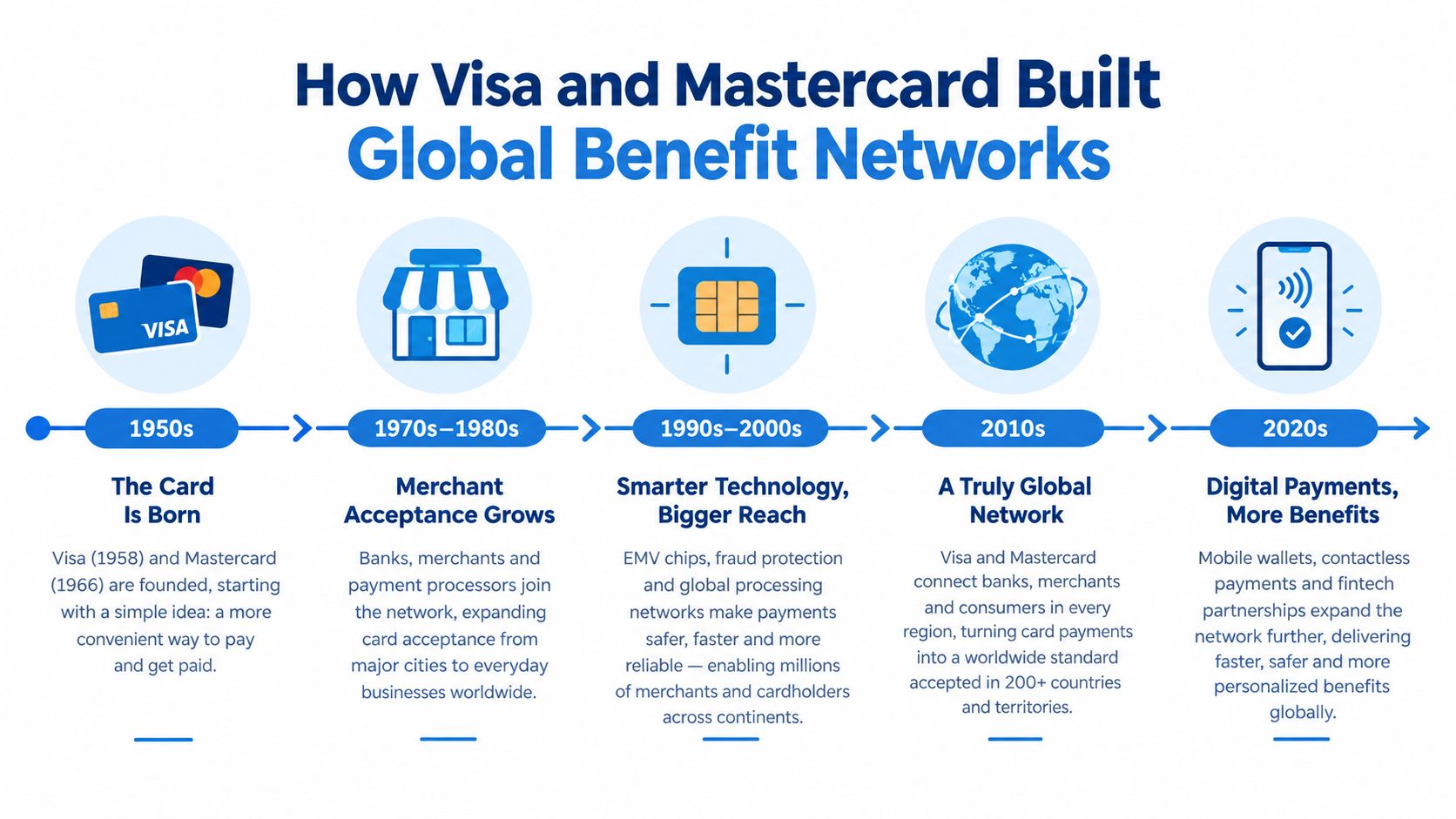
Visa's network lineage traces back to BankAmericard in 1958 and the Visa name in 1976, while Mastercard's modern brand dates to 1979, when Interbank/Master Charge adopted the Mastercard name. Recent industry summaries report Visa operating in more than 200 countries and territories and Mastercard in more than 210. That global build-out helps explain why lounge access programs, travel protections, purchase protections, and premium service layers are commonly bundled around these two networks rather than around smaller alternatives, according to this industry comparison of network history and reach.
Scale is what makes benefits portable
A travel benefit only matters if the card works where you travel. A purchase protection policy only matters if the merchant category, issuer, and processing path align cleanly enough for the card to be useful in the first place. Network scale solves part of that problem by making the card broadly usable before the issuer adds product-level perks.
That scale is also unusually stable. In the United States, Visa accounted for 70.38% of combined Visa-Mastercard purchase volume in 2025, or $7.028 trillion, while Mastercard held 29.62%, or $2.958 trillion, according to Nilson Report data cited in 2026 industry coverage on Visa's market position. For cardholders, the implication isn't that one network automatically gives better benefits. It's that both networks have the transaction base to support strong issuer programs over time.
Why crypto card users should care about that history
Crypto card programs don't build merchant acceptance from scratch. They inherit it by attaching themselves to existing card rails. That's one reason many crypto issuers choose Visa or Mastercard even when the rest of the product feels very different from a bank card.
If you're trying to understand why a crypto card can still slot into premium travel behavior, it helps to think of the network the way people think about concierge-driven hospitality ecosystems. The service layer only works because a much larger operational network sits underneath it. That same logic shows up in a very different context in this guide to a luxury travel network explained, where access and consistency come from the network behind the experience.
For stablecoin-oriented infrastructure, it's also useful to see how card rails are converging with newer payment models. This overview of the Visa stablecoin platform and OpenUSD context is relevant because it shows how network reach and digital asset payment design are increasingly linked.
Visa vs Mastercard Benefits Compared by Category
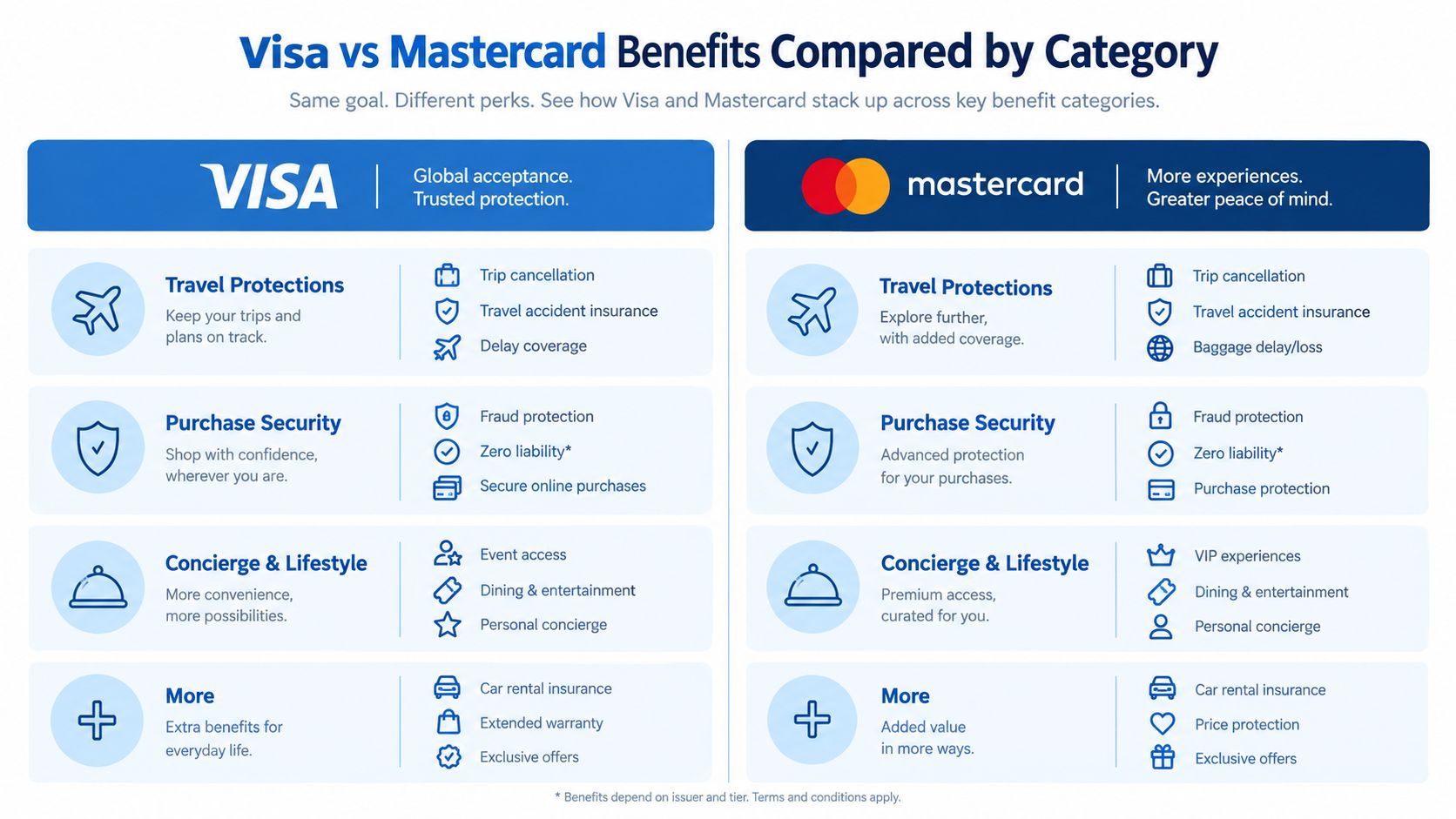
Most benefit comparisons become clearer once you stop asking for a single winner and start comparing categories. Visa and Mastercard both support familiar premium card perks, but they don't tend to emphasize exactly the same things. Broadly, consumer guidance notes that Visa often leans toward travel and emergency services, while Mastercard more often emphasizes discounts, experiences, and identity-theft tools, though those differences are inconsistent across tiers and may barely matter on entry-level cards, as noted by CNBC Select's discussion of issuer- and tier-dependent network benefits.
Travel protections and emergency support
Visa's reputation in this category tends to center on travel-related protections and emergency assistance. If you're using a premium Visa product, the travel framing is often more visible in card marketing and benefit guides.
Mastercard also appears in strong travel products, but its network identity often feels less centered on emergency travel language and more blended with lifestyle and access features. For crypto card users, that distinction only matters if the issuer has licensed or included those protections in the product package.
The useful question isn't “Does Visa have better travel benefits?” It's “Did this specific issuer include travel benefits on this specific card tier?”
Purchase security and post-purchase protection
On purchase protection, return support, and extended coverage, the gap between the two networks is usually narrower than comparison pages suggest. Premium cards can include meaningful protections on either network. Entry-level cards often don't.
For crypto-linked cards, there's an extra wrinkle. Even when a benefit exists in theory, reimbursement mechanics may be less intuitive if the card is prepaid, region-limited, or subject to issuer-specific exclusions. A benefit list matters less than the claims process and card agreement.
A practical way to judge this category is to look for:
- Claim clarity: Does the issuer publish a benefit guide with exclusions in plain language?
- Transaction fit: Does the protection apply cleanly to digital wallet, travel, and cross-border purchases?
- Program structure: Is the card credit-like, debit-like, or prepaid in a way that may affect coverage scope?
A related issue is value leakage. Cashback and benefits can look attractive until fees eat them. This is why comparisons such as whether crypto card cashback is worth it often do more for decision quality than perk lists alone.
Concierge, experiences, and lifestyle extras
Mastercard often feels more differentiated. In many card ecosystems, Mastercard products are associated with discounts, curated experiences, and lifestyle access. Those perks can be useful if you'll use them. They can also be noise if your real concern is reliable spending from a self-custody or exchange-linked balance.
Visa's premium products also offer concierge-style support, but the identity tends to be more practical than experiential. That can appeal to frequent travelers who want emergency replacement or assistance more than event-oriented extras.
The video below gives a consumer-facing overview of network differences. Use it as a supplement, not a substitute for reading the issuer's terms.
Fraud tools and account security
Both networks support mature fraud monitoring environments, and neither has a monopoly on safe card use. What matters more is how the issuer deploys controls, alerts, wallet support, and dispute handling.
Crypto card users should be especially skeptical of generic “security benefits” language. In this category, some of the most important protections aren't branded perks at all. They're operational details such as freeze controls, transaction notifications, support responsiveness, and clean wallet token provisioning.
Why Issuer and Tier Matter More Than the Network Logo
The biggest misunderstanding in Visa vs Mastercard benefits content is that the logo determines the experience. It rarely does.
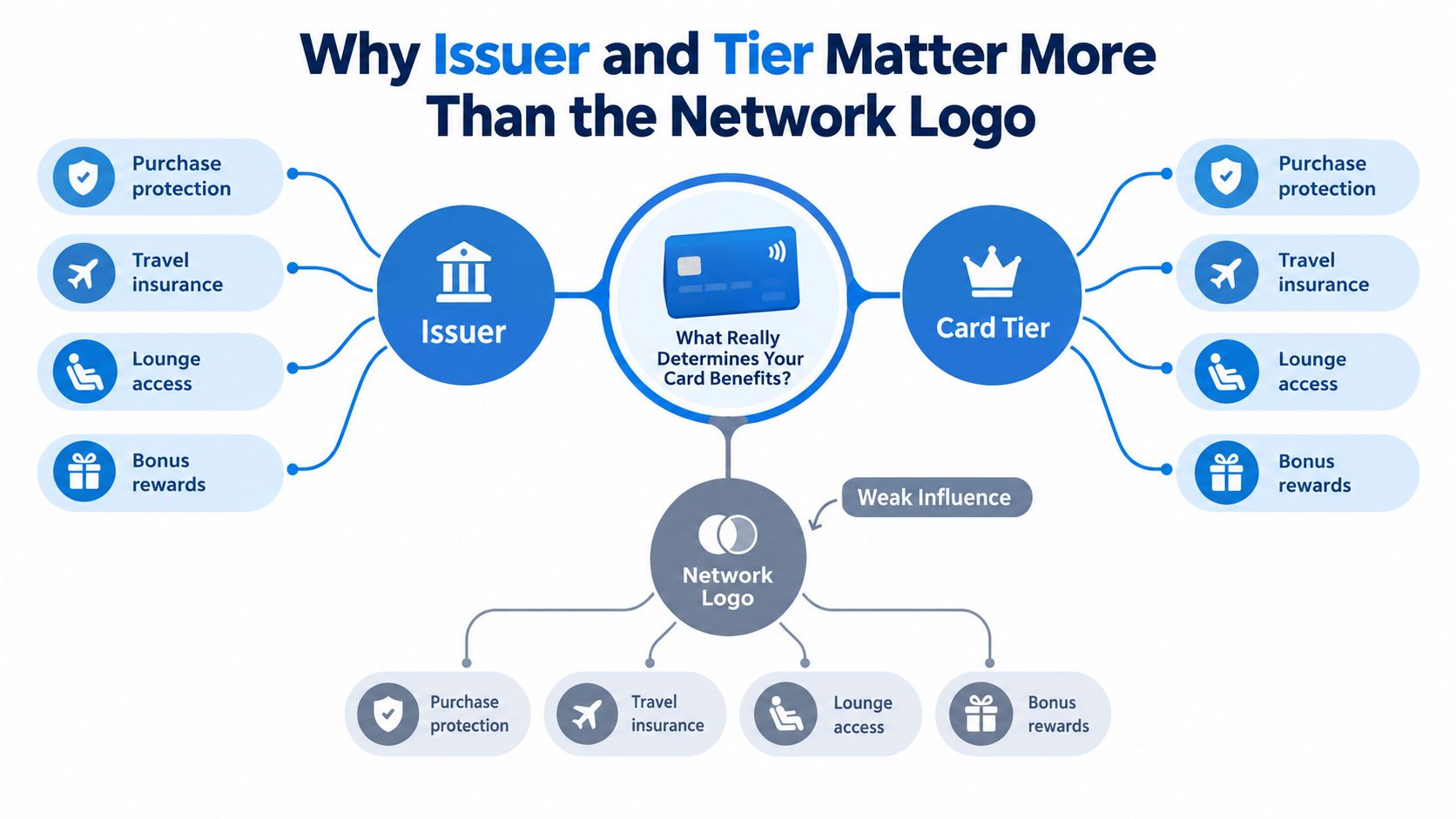
Major consumer guidance is explicit on this point: benefits such as purchase protection, travel insurance, and concierge access vary by issuer and card tier, not by whether the card carries a Visa or Mastercard logo. That means switching from one network to the other often won't improve your benefits unless you also change to a different product design.
The logo is the outer layer
Think of the network as the rail and the issuer as the architect of the offer. The issuer decides what economics to pass on, which protections to include, how claims work, what fees apply, and whether a premium tier is premium or just marketed that way.
That distinction matters even more in crypto cards because the issuer may also determine:
- How conversion happens between crypto and fiat
- Which regions are supported for issuance and spending
- Whether the card is custodial or linked to a self-custody flow
- What KYC burden applies
- How support handles disputes, reversals, and failed transactions
A Visa Infinite-style concept on paper doesn't tell you much if the crypto issuer strips the package down or adds conditions that make the benefit hard to use.
Tier can change everything
Within the same network, moving from a basic product to a premium tier can produce a much larger difference than moving from Visa to Mastercard or back again. That's why entry-level cards on both networks often feel functionally similar, while premium cards on both networks can feel quite different even inside the same brand family.
Decision shortcut: Compare two cards at the same functional level first. Match debit to debit, prepaid to prepaid, travel card to travel card, and premium tier to premium tier. Only then compare the network.
Why this matters more for crypto than for bank cards
Traditional credit card users often focus on rewards and lounge access because the rest of the banking stack is familiar. Crypto card users face a broader trade-off set. A card with weaker visible perks may still be the smarter choice if it has cleaner custody design, lower friction, better regional support, or fewer hidden fee layers.
That's why network-first shopping tends to mislead this audience. If you're deciding between two crypto cards, ask the issuer questions before you ask network questions. What assets can you spend? Is there a markup hidden in conversion? Is the virtual card available in your country? Does the product require full KYC? Those answers usually change outcomes more than the badge on the front.
Network Performance for Travel and Online Crypto Card Use
Benefit pages rarely focus on the point where many crypto card users feel the difference first: authorization. A card can have an attractive perk stack and still be frustrating if online checkouts fail, recurring billing breaks, or foreign transactions behave inconsistently.
One concrete data point matters here. A 2026 payments-industry summary cites Visa's own figure that network tokenization lifts authorization rates by 4.6% versus raw card numbers, which is especially relevant for e-commerce and recurring billing flows where failed authorizations directly disrupt spending, according to Solidgate's summary of Visa tokenization performance.
Network Capability and Acceptance Signals for Crypto Card Spending
| Capability | Visa Signal | Mastercard Signal | What to Check on Your Crypto Card |
|---|---|---|---|
| Online authorization | Reported uplift from network tokenization in card-not-present flows | Mature tokenization stack described as broadly similar in core capability | Ask whether the issuer provisions network tokens for wallets and online merchants |
| Recurring billing | Strong fit where tokenization is deployed well | Also viable, with practical results depending on rollout and issuer adoption | Test subscriptions you care about, not just one-time purchases |
| Contactless use | Mature contactless support | Mature contactless support | Confirm mobile wallet support and local availability |
| Cross-border acceptance | Slightly broader overall in some comparisons | Marginally wider in some markets in other comparisons | Check issuer-country pairing and your travel region |
| Fraud monitoring environment | Mature | Mature | Look at issuer controls, alerts, and support speed |
Independent merchant-facing commentary describes both networks as offering similar tokenization, contactless, and fraud-monitoring capabilities. The practical difference is usually rollout and issuer or merchant adoption speed, not a dramatic feature gap. The same comparison notes that Mastercard's acceptance is marginally wider in some markets, while Visa's is slightly broader overall in others. The right conclusion is not that one network wins globally. It's that local gaps are usually small and should be tested at the issuer-country level, as discussed in this 2026 Visa versus Mastercard network capability comparison.
Cross-border spending is about implementation, not just perks
For travel, the better question is often “Which card program works cleanly where I go?” not “Which network has nicer headline benefits?” Consumers looking at travel cards sometimes get stuck on glossy reward framing, but the value comes from whether the card works predictably in the places and channels you use. That's the same underlying question explored from a more general traveler perspective in are travel credit cards worth it.
There's also a structural shift in the market. Independent payments coverage reports that the major U.S. Visa and Mastercard interchange settlement is expected to reduce the combined average effective credit interchange rate by 10 bps for 5 years and cap key U.S. consumer rates at 125 bps for 8 years. The same coverage notes that Visa Platform Connect now supports Mastercard domestic transactions with installment options, which points to growing interoperability and a weaker case for simplistic network tribalism, according to this merchant-focused settlement and interoperability analysis.
If you travel frequently, country-specific usability matters more than broad claims. This guide to a crypto card for travel and nomad FX needs is useful because it frames card choice around spending abroad rather than around generic rewards copy.
Choosing the Right Network for Your Crypto Card Use Case
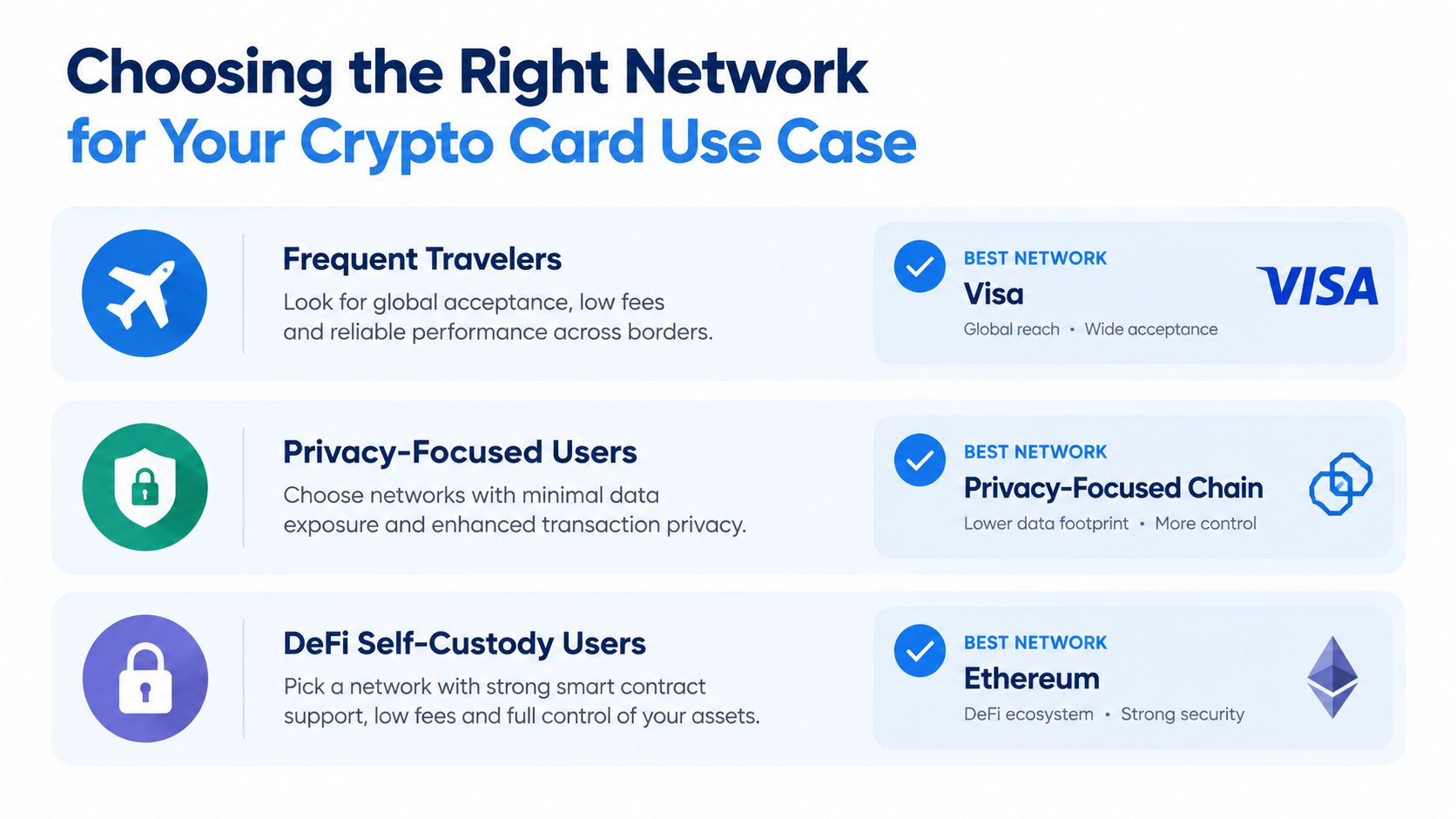
There isn't a single winner for every crypto card holder. The smarter approach is to map the network to the use case, then check whether the issuer's design supports that use case cleanly.
Frequent travelers and digital nomads
If you spend across borders, use online travel merchants, and care about premium support language, a Visa-leaning setup can be appealing when the issuer includes meaningful travel and emergency services. That can matter if your card is used for flights, hotels, and irregular cross-border purchases.
Still, don't stop at the network. A weaker issuer can negate the advantage quickly through poor regional rollout, clumsy FX handling, or stripped-down protection terms.
Privacy-focused users
If your first filter is low-friction onboarding or reduced data exposure, the network should usually be a secondary concern. The issuer's KYC model, funding method, and jurisdictional limits matter more than whether the card is Visa or Mastercard.
In this segment, a Mastercard program with modest perks but cleaner issuance conditions may be the better fit than a more glamorous Visa card. The same can be true in reverse. The network logo rarely solves privacy trade-offs.
DeFi and self-custody users
Self-custody users should prioritize spending architecture over perk branding. If one program offers a more transparent link between wallet control and card spending, that usually outweighs the soft differences between network benefit families.
Pick the card that preserves your preferred custody model and works where you spend. The network comes after that.
For this audience, the best network is often the one attached to the card with fewer operational compromises.
Rewards optimizers
This group is the most likely to overrate network branding. Lifestyle extras, concierge language, and travel positioning can all be useful, but only if the rewards hold up after annual fees, FX costs, asset conversion spreads, and exclusions.
A rewards optimizer should ask:
- Does the issuer pass through real value?
- Are the benefits usable in my country and spending pattern?
- Will the network support clean acceptance in the channels I use most?
If the answer to the first two is weak, the network won't rescue the card.
How to Evaluate and Pick Your Next Crypto Card on NomadCards
A workable card decision starts with elimination, not aspiration. Filter out cards that don't match your country, custody preference, KYC tolerance, or asset needs before you spend time comparing travel copy and premium badges.
One practical workflow is:
- Filter by hard constraints first. Network, supported coins, region availability, physical versus virtual issuance, and KYC level should come before perks.
- Check the issuer-tier combination. Don't assume a Visa or Mastercard logo tells you what protections are live on that product.
- Read the standardized profile carefully. You want the annual fee, cashback structure, network, and country support in one place before clicking through to the issuer.
- Estimate effective value. Rewards only matter after conversion friction, FX handling, and any monthly or annual cost.
- Verify edge-case usability. If you depend on Apple Pay, Google Pay, ATM access, or recurring billing, confirm those points directly.
A comparison database is more useful than a generic blog post. NomadCards aggregates crypto-linked card programs and lets you filter by KYC level, network, supported assets, card type, and features such as virtual issuance or self-custodial design. Because profile fields are normalized, it's easier to compare cards that would otherwise be presented in completely different issuer formats.
For readers who also think in points-and-miles terms, a broader rewards perspective can help you sanity-check whether premium card positioning matches your habits. This guide on how to maximize travel points with Approved Experiences is useful for that purpose, especially if you're weighing crypto card rewards against conventional travel strategies.
A good final test is simple. If you removed the logo from the front of the card, would you still choose the same product based on fees, access, custody, and usability? If the answer is no, you're probably overvaluing the network and undervaluing the structure of the card itself.
If you want to compare crypto cards without guessing which benefits are real, NomadCards gives you normalized data on network, fees, rewards, custody model, KYC requirements, and regional availability in one place. That makes Visa versus Mastercard a useful filter instead of a misleading headline, and it helps you choose the card that fits how you spend.